Wednesday, 13 November 2013

Money, money, money

For the love of money is a root of all sorts of evil, and some by longing for it have wandered away from the faith and pierced themselves with many griefs. - Timothy, 6:10

It's not often that I look to the Bible for gems of wisdom, but I find this particular extract ubiquitously true. I've often heard it paraphrased as "money is the root of all evil", but I think that misses out a crucial human element. Currency in itself is neither evil nor benevolent; but the pursuit of wealth, the ease with which we exploit fellow humans in a bid to maximise profit and reduce expenditure certainly forms the foundation of pretty much every worldly evil I can think of that we visit upon one another. I've pondered this one for a while and I cannot think of one single atrocity that cannot be traced back to money. 

Periodically, I struggle with writing about humanity. I find myself drawn into existential crises, unable to justify why we spend so much of our lives worrying about things that really - in the grand scheme of things - just do not matter. I watch the news and despair at how unkind we are to each other, whether that's one person committing a violent crime against another, entire governments carrying out appalling attacks on their own citizens, or deeply ingrained social attitudes about immigration, benefit claimants, drug abusers, obesity, mental illness, etc. It alarms me even more when I put this into the grander context of civilisation and realise that we are pretty much living in a golden age of compassion, by historical standards at least. There is not a single period in history that springs to mind where human beings were habitually kind to one another and endeavoured to improve the lives of their fellow men and women for no reason other than that they could. Instead our history books are overflowing with records of war, torture, oppression, slavery, bigotry and murder. Yes, this is all punctuated with notable examples of philanthropy, but the fact remains that the instances of People Being Nice To Each Other are comparatively few and far between.

In essence, human beings, as a species, are not very nice. And that's before we get anywhere near how we treat animals and our planet. This is only dealing with how we behave towards each other. 

It all comes back to money and the acquisition of wealth. I've posted before about global corporations exploiting the poor and doing an astonishingly good job of covering it up, because they have the means to do so. Global industry is so rife with this sort of behaviour, that it's very difficult to buy "necessary" products that are 100% ethically sound. I do not wish to perpetuate the exploitation of my fellow man but the likelihood that my clothes, furniture, mod-cons and food were all manufactured by companies endeavouring to ensure that every member of staff at every level of production was properly paid, well treated and happy is slim to none. Why? Because business need to make profits. Bigger profits than their competitors. Oh, and they need to keep the costs for the end user at the lowest possible so they don't lose customers to competing companies, so profits can't come from hiking up the prices at that end. The profit margin has to be struck between minimising the cost of production and offering a attractive price to the masses. The company who can come up with a way to strike that balance will be a ground breaker indeed!

Business isn't the only culprit. Socially, we (at least in the developed world and specifically, for the purpose of this rant post, the UK) are greedy and invest far too much emotion in the value of Stuff. I read a fantastic piece a few days ago about the audacity of poor people daring to own shiny things (here) and it really brought home to me how ludicrously cyclical the whole thing is. Appearing to be well off is important, even if you're flat broke, so we have credit options for those without the actual cash to buy the latest commodities and endless upgrades to quickly outdate the latest shiny thing for those who do have this kind of disposable income. Oh, but be careful not to flash your non-existent cash too much or you risk incurring the wrath of... well... of people who think they have the right to pass judgment on whether you fall under the banner of the "deserving poor" or the "undeserving poor".

It's all changing at the moment. It used to be ok to be poor; there was a reasonably decent welfare system to stop you from hitting rock bottom and a bearable stigma to claiming from it legitimately. Then something happened, a sea change came upon us and now we face an extraordinary conundrum where even middle of the road earners cannot afford to own or rent their homes, pay their bills AND put food on the table without an income top-up from the state but our newspapers and social media chatter are filled with extreme and inflated examples of the workshy fiddling the system to fund a decadent and frivolous lifestyle. If this was your only source of information, you could be forgiven for thinking all poor people are scheming and manipulative, plotting their next move to extract cash from the hard-working wealthy upper class, all while the poor fatigued government endeavour to instil some manner of work ethic into the nation. Yes, Mr. Cameron, I'm looking at you again. 


It's not even ok to be disabled anymore. Just in case you were wondering... I have always believed that you can judge how civilised a country is by how they treat the vulnerable and the deviant. Our deviants are probably not doing too badly, compared to the rest of the world. We don't have capital punishment anymore, we don't (officially) carry out or endorse torture. There are massive gaps in the efficacy of our justice system, but I'll take it over that of the USA or China, thank you very much. 

Our vulnerable, however, are not faring so well. Thanks to New Labour's moves to reduce the number of Disability Living Allowance claimants - and let's not forget, for all that I loathe about the Conservative party, it was New Labour who brought in ATOS - even the life-limitingly unwell are targets. Got cancer? Well you can still sit in a chair and type, right? You over there - missing three limbs? Pfft! That one remaining arm could stack shelves! Mental illness? What's that?! 

Medical assessments of a person's fitness for work are being carried out by people with no medical background. Consequently, people who are utterly unemployable are told that their disability benefits are to stop and they must try to find someone who will give them a job and then hope to God that they can actually turn up to work every day and fulfil the requirements of that job without either being fired for unreliability or dropping dead from the stress and strain. 

Why are we doing this to people? Because the government need to save money and reduce what they're spending. Never mind the fact that benefits make up a TINY fraction of their annual expenditure - in fact, in the last fiscal year, more was paid out in interest on national debt than on unemployment benefits. Poor people make an easy scapegoat because we don't have the means to fight back. 

Once again, it's all about money. WHY do we accept it? The government have constructed a very helpful rhetoric, demonising those with the temerity to be poor and we are buying into it. Those who fight back are quickly dismissed as bleeding heart lefty liberals. Well I know where I would much rather align myself.

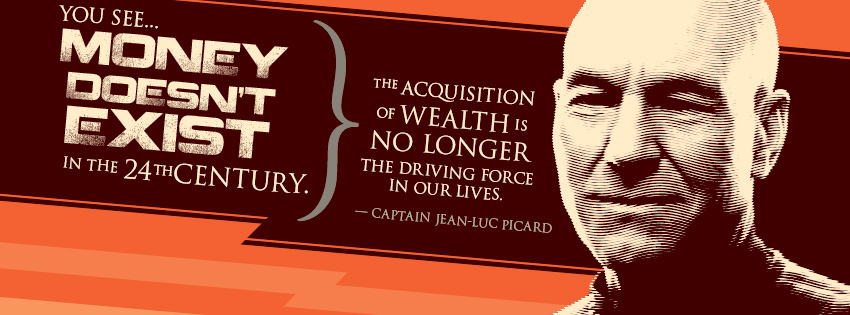
I fully intend to post again about this issue, hopefully in a less ranty capacity. In the meantime, I'll leave you with this thought:

Testing, testing. 1, 2, 3...

Hello blogworld. It's been quite a while since I posted anything, mostly because life has been a little crazy here. Things are settling down again now so I'm hoping to find the time to write a bit more about the millions* of ideas I have swimming through my head at the moment. Between the government offering monetary incentives to mothers for breastfeeding (WTAF?), to Katie Hopkins vs Peaches Geldof, from Christmas madness to crochet heaven - there's lots I want to write about. 

Right now, I'm going to make a cup of tea, deploy the electronic babysitter and get back to work on some posts that have been in the pipeline for a few weeks. 

*not literally

Monday, 2 September 2013

Meet Ted: the Duracell Bunny Baby

The concept of a Duracell Bunny Baby is something I first came across on the Analytical Armadillo blog; it is a neat term for babies who have boundless energy and Do Not Sleep. Naps, night-time - sleep does not come easily to these little fireballs. 

Fifteen month-old Theodore is one such baby. 

Do not be fooled by the cuteness. This was taken at 11pm. He is laughing at my attempts to make him SLEEP.


A year ago I wrote a post about bedsharing and how the first three months of sleeping with Ted in our bed had gone. At that point, I was still confident that within a few months, he would make the gentle transition to his cot as my three previous children have done. The theory is simple: at a certain age, my babies have each started sleeping from late evening through to the small hours of the morning. This is when they are put into the cot; when they wake, I put them in my bed until morning. That's not an ideological thing. I'm just too lazy and fond of sleep to spend hours pacing the bedroom rocking them back to sleep. Eventually, the time between putting them down and them waking again stretches out until they sleep through in their own room of their own accord.

Beautiful, yes?


The other Smalls enjoying their time snuggled in my bed.


Please explain this to Ted! At fifteen months, he still does not nap for more than half an hour at a time and even that is dependent upon being held by someone. Occasionally - rarely - we are able to put him down on the sofa. We've successfully managed an hour or two stint in the cot on fewer than half a dozen occasions but the general rule of thumb is that children one, two and three go off to bed at 7pm and are asleep by 8pm. Ted gets into his pyjamas at the same time and the attempts to make him Go To Sleep begin. It might be me feeding him, Andy walking round the room rocking him, putting him down somewhere and singing/patting/ssshing him. Ninety-per-cent of the time NOTHING WORKS and at 10pm, the little bugger is still literally bouncing round the lounge and giggling at us. 

Last night, it was midnight before he finally gave in and nodded off. 

I don't do controlled crying at all, and even if I was prepared to consider it, it would be a very bad idea for Ted as he's prone to breath holding attacks and goes blue if he cries. There are also three other children in this house who have to get up early for school, so having a crying baby around just wouldn't be fair on them. I've beaten myself up, analysed all my decisions about bedsharing and breastfeeding and blamed myself over and over again for creating the Incredible Non-Sleeping Baby, but then I remembered reading about Duracell Bunny Babies. 

Reading down the list of bullet points on the Analytical Armadillo post about DBBs, it describes Ted to a tee. I'm so relieved to be able to tell myself this is not my fault. This is not a "something wrong" or a way I've broken the baby. It does, however, mean I don't know how to put it right and get this boy sleeping in some kind of vaguely sensible pattern.

Thankfully, once Ted has given in and dozed off he stays mostly asleep as long as I lie right next to him. If I move away, all hell breaks loose but there is honestly nowhere I'd rather be at 2am than lying in my bed, so that's not an issue. It would be MARVELLOUS if he spent some time asleep in his own bed though. I was mentally prepared for six months to a year of bedsharing and breastfeeding, but Ted seems intent on continuing both. He does seem a lot younger - if that doesn't sound daft - than my other children did at this age, so maybe this is just him taking in life at his own pace. 

I must keep reminding myself to just relax and embrace all the little bits of babyhood while I still can. He will grow up soon and eventually forge his independence and then I know I'll miss his evening antics and afternoons spent with him snoozing lightly in my arms while I will the rest of the world to shut the hell up lest they wake him.

This too shall pass.... this too shall pass.... Where's the gin?

Wednesday, 28 August 2013

Miley Cyrus and Accidental Racism

Right then. I couldn't resist any longer. A post about Miley Cyrus' performance at the VMAs this week...

I feel I should preface this post with a couple of points:

  • Before yesterday I didn't know what "twerking" is
  • Before yesterday I only had a vague grasp of what a Miley Cyrus is
Ninety per-cent of the discussion I've read about this performance has focused on its overtly sexual nature, speculation on Cyrus' drug usage, eyebrow-raising at that really weird tongue thing she does and the inappropriateness of broadcasting this routine to an audience of impressionable children and young teenagers. Until that is, Caitlin Moran retweeted a link to a blog exploring its racial implications.

I read the blog a couple of times, trying to take in the message. In all honesty, at first I felt it was overanalysing somewhat, looking for issues that weren't there. But then I'm not a black woman; I have never had to consider that traditional feminism doesn't account for specific issues faced by women of different ethnicities. That's when I started to deconstruct my own feelings about this blog post, the VMA performance and other forms of normalised "accidental" everyday racism. 

I still don't think Miley Cyrus' dance routine (I'm being generous in calling in that!) was overtly racist in the same way it was overtly sexual. But it DOES perpetuate accepted stereotypes about black women and representations of their sexuality.


To me, being racist means a deliberate and conscious act which harms or denigrates one or more people based on the colour of their skin and/or aspects of their culture. 

I don't think that applies to Miley Cyrus in this instance. What I do see in her performance is what I've called "accidental racism"; that is, an unconscious attitude towards (in this case) black culture which stereotypes and misrepresents a key intimate aspect of black women's lives. 

The fact that the racial implications of the performance need to be highlighted is entirely the point. We don't see this as 'racist' because such representations of black women and black culture have become normalised to us. A few decades ago, it wasn't seen as sexist to market a kitchen product to women in this manner because demeaning women was normal and accepted. It has taken many years to challenge that and begin to eradicate sexism, and yet we still see adverts for cleaning products, supermarket chains, etc. that focus their preference by mothers as their unique selling point. And yes, when people complain that such adverts are sexist, we're told that we're overanalysing and looking for issues that aren't there - because attitudes that cleaning and grocery shopping is the preserve of the little wifey at home are still normalised.

It is possible to perpetuate damaging racial stereotypes without realising you're doing it. This insidious form of oppression is much more difficult to challenge because it first requires an awful lot of work to demonstrate that it even exists and that you're not grasping at straws to find it. 

A few days ago, a friend published a link to a series of "automatic preference" tests, one of which looks at whether you lean towards or away from black or white people's faces. I have NO idea how it works, but when my results were given, it also gave a breakdown of the total number of respondents and the average result. Staggeringly, the majority - over a quarter - of respondents were found to have an automatic preference for white people over black people. This means that without any conscious decision making, they found a white face more tolerable than a black face. THIS is entirely what is meant by accidental racism. 

Here are the tests if you'd like to explore for yourself: https://implicit.harvard.edu/implicit/uk/selectatest.jsp

One final thing I would like to say on this matter is that I don't hold Miley Cyrus 100% culpable for the content of her performance. There is a team of stylists, choreographers, managers and broadcasters who need to ask themselves what the hell they were thinking when they decided this was a really great routine for a young, female artist.


Tuesday, 27 August 2013

Winter is coming...

Something a little more lighthearted for me today!

It smells slightly Autumnal today, and I'm very excited. It's about 18 degrees outside, so a bit cooler than recent weeks and there's a hint of something russet, red, golden and crunchy in the air. 

I love Autumn; it's definitely my favourite season. The colours are so exciting, their warmth contrasting against the bite in the wind. Putting away floaty dresses and tops, bringing out the snuggly jumpers, scarves and boots - it's like that most excellent part of the day where you start to wind down and relax, shaking off the frenetic activities of the day and embracing a quieter, more pensive time. 

I eagerly anticipate evenings spent in twilight, drinking hot chocolate and warming chilled fingers and toes by the fire. 

Tuesday, 20 August 2013

The day human rights went out the window.

Yesterday was a really scary news day. The detention of David Miranda at Heathrow airport under schedule 7 of the Terrorism Act 2000 has sparked outrage and nationwide, if not global, questioning of the incident and its wider implications. 

In short, if you've missed any of this, David Miranda is the partner of Guardian journalist, Glenn Greenwald, who has recently reported on Edward Snowden and assorted surveillance programmes in the United States. To clarify - Greenwald is the journalist, not Miranda. Whilst travelling through the UK en route to his home in Brazil following a trip to Berlin, Miranda was stopped by border officials and detained for NINE HOURS. That is nine hours without the presence of a lawyer, legally compelled to answer any and all questions asked of him, and having all his personal effects - mobile phone, laptop, even a video game - confiscated. After nine hours he was released without charge or arrest, basically because he had done nothing wrong.

That is horrifying. What is even more horrifying is that this incident was "legally and procedurally sound" according to the UK Home Office. The law accommodates this sort of action against an entirely innocent person, denying them the right to silence, exposing us all to arbitrary detention, intimidation and interrogation.

I decided to have a look at the Terrorism Act 2000 and learn a bit more about it - know thine enemy, etc. Good grief, it is terrifying. Ironic for a piece of legislation intended - if taken at face value - to combat terrorism. 

Schedule 7 refers to Port and Border Controls, and amongst other things says this:


"whether or not he has grounds".... whether OR NOT

As it happens, section 40 (1)(b) refers to the definition of a terrorist, but I think that's pretty much irrelevant just now seeing as this little sentence gives officers the right to detain absolutely anyone, regardless of whether they have reason to believe you're up to no good. 

That is, they have the right to arbitrarily stop you on you journey, take you to a small room, deny you access to legal representation, confiscate your belongings and interrogate you non-stop with questions you are forced to answer. And there is nothing, nada, zip, zilch we can do to stop it. 

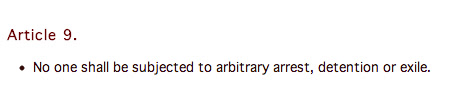
I'm not alone in suspecting that David Miranda's human rights have been infringed here, and a cursory glance at the Universal Declaration of Human Rights confirms that.


Well I don't know about you, but I'm really quite frightened. A year ago, I wrote a three part post about Human Rights and Human Wrongs (links to parts one, two and three), explaining why I champion the human rights of even the most abhorrent of criminals. I said then that it is because we observe human rights as universal and absolute that I could sit in safety and write about such issues, free from the fear that I could be arrested, tortured or worse. Once we started rescinding human rights of individuals and citing reasons they 'deserve' it, we are on a slippery slope to a very scary place. It takes very little for a government to move the goal post to define a "suspected terrorist" and then justify treating them in manner which wholly violates their human rights. 

Today the UK Home Office has defended the treatment of David Miranda. And that really frightens me too.

Monday, 12 August 2013

The question parents dread to hear...

It used to be that the most awkward question your child could ask was "where do babies come from?". A pivotal moment in your child growing up; making the leap from innocent belief in fairies and storks, to the bare and frankly slightly gross reality of S-E-X. 

We crossed that bridge with my eldest boys a while ago. Their school started sex education classes from Year 1, beginning with simple things like the correct anatomical names for genitals and discussing family relationships. I have a fond and honestly not at all cringe-worthy moment of Lucas bounding out of school one afternoon, very excited to know the proper name for his private parts and loudly declaring that he also knew the name for what women have - "it's FLANGINA, isn't it Mum!". Don't worry, he knows the proper name now and the novelty of singing songs about private parts has almost worn off. 

So far it's been a pretty painless experience, although we're yet to get to the mechanics of what goes where. I'm resolved to stick with honest, age-appropriate answers to their questions as and when they ask me. For now, the boys have decided that sex sounds gross and they'd rather hear about the details when they're older. I'm cool with that but remain slightly concerned that they'll pick up some weird interpretation of it from playground gossip. 

That's something you just can't account for when you have children. You can plan out what you'll teach them and when, but there's just nothing you can do about the stuff they hear at school from other kids. It's actually more alarming than I'd ever realised. Lucas has often come home from school puzzled or upset by something he's overheard, and it's lead to many discussions about racism, sexism, violence, bullying and so on. I feel he's more world-aware than I was at his age and all of it prompted by things he's picked up outside of my control. 

So, back to the question he asked this week which filled me with dread. 

"Mum, when can I have a Facebook account of my own?"

Oh, good lord. Never. Never ever ever. I've seen the Facebook pages of some teens and pre-teens (forgetting for a moment the T&Cs about a minimum age of 13). Some of them are HORRIBLE; admittedly no more horrible than those of some adults but it shocked me to see kids behaving like this. Thinking back to my school days, I'm pretty sure kids are no more or less horrible than they used to be, but social networking is a whole new platform for them to explore that whole mess of hormones, relationships, friendships, conflict and general awfulness that comes with adolescence. Not only that, but once something is out there on the internet, it's there forever. Even deleting stuff doesn't make it go away. 

In the same week as news broke of the terribly tragic death of Hannah Smith, people are again talking about cyber-bullying and how to tackle it. I've only come vaguely close to the receiving end of this, following a fall out on Twitter with a certain celebrity "doctor" who proceeded to invite his followers to send me unpleasant messages. For the rest of that evening I was inundated with insults, threats and assorted nastiness. It was upsetting but thankfully over after a few hours. I cannot begin to imagine what that must feel like over a prolonged period of time. The internet breeds anonymity and with that a sort of perverse courage to type things you would never say to a person's face. 

How do I introduce my children to the universe of social networking and adequately protect them from this aspect of it? I'll be buggered if I know! This stuff didn't exist when I was a young'un. Mobile phones were barely in circulation and certainly couldn't take photos or upload things instantaneously to the internet. 

My eldest son is only 8 so I have a few more years where I can get away with telling him he's too young for the likes of Facebook, but given that he's already remarkably tech-savvy I think I have some research to do about protecting children online.