It makes sense to ease myself back into regular blogging with a familiar topic, but this time I'm writing from a new perspective. Something I've never encountered before. I'm apprehensive about saying the words out loud or writing them down here, so this post feels a bit brave for me.
I would like to stop breastfeeding.
There we are; just six little words that have caused me a huge headache in the last month or so!
This concept is new to me because, although I've breastfed all of my other children when they were babies, they each lost interest by the time they turned a year old. I've never had to wean a baby off before, or find alternative ways to get them to sleep at night! Ted is coming up to 13 months old and still very much my little squashy baby. He likes food, but still breastfeeds half a dozen times a day at least, as well as on average twice a night. He still sleeps in my bed, although we've tried (and failed!) to move him into his cot once he's nodded off. He knows! He can be in the deepest sleep, snoring his head off and the very moment he touches the cot mattress, his eyes fling open and he cries as though he's been abandoned for tigers to eat.
I don't mind him sleeping in my bed for the foreseeable future. He's a lovely, cuddly companion and a big part of me will miss having baby snuggles once he's outgrown us. I don't actually know why I feel I would like to stop breastfeeding. I just would. I've loved every minute of it, never minded missing out on nights out, never felt it was a burden to be his sole source of nutrition for the first 6 months. It doesn't bother me now; people tell me he's only using me for comfort, but that's fine. That's what I'm there for! It's just... I don't know. I'd like my body back. I'd like to be able to buy pretty summer clothes without first evaluating them for ease of boob access and degree of discretion for feeding. It's a vanity thing, pure and simple. I don't mind admitting that. Or maybe I do... I don't want to be called selfish for feeling this way and I don't think anyone with a shred of sense about them would say anything like that, but there's a lingering voice at the back of my mind that knows Ted still needs me, in his own little world.
So! Lovely readers... I need some help. I need some tips and advice for gently easing him off breastfeeding. It doesn't matter if it takes weeks or months, so long as it works without breaking his heart! He's quite fond of his sippy cup but all my attempts to introduce formula or cows milk as a drink (I cannot for the life of me express more than a few drops!) have been met with a look of disgust.
I'm sort of trying "don't offer, don't refuse" at the moment but he's quite persistant and doesn't mind letting me know when he thinks it's time! Dummies get thrown at my head. Bottles make excellent tools for banging on the coffee table, but nothing more.
Any suggestions?
Showing posts with label attachment parenting. Show all posts
Showing posts with label attachment parenting. Show all posts
Wednesday, 12 June 2013

Thursday, 30 August 2012
The big bad "B" word - bedsharing
I'm going to try and resist the temptation to write a load of "for" and "against" points in this post. There is a wealth of evidence that sleeping in the same bed as your baby is perfectly safe as long as you observe a handful of safety points, all of which are nicely summarised here. This post is simply my personal experience of it, particularly in the last 3 months since my youngest son was born.
I first discovered bedsharing quite by accident. My first son was about 3 weeks old and I was beyond sleep-deprived. He was not an easy baby by any means, especially when it came to sleeping. He hated his Moses basket, screamed if put in a cot, snoozed briefly in the car seat as long as you stood up swinging it back and forth but woke the moment you put it down. After 3 weeks, I was deranged with tiredness. My friend's mum, a wonderful midwife, came to visit and asked me if I'd tried lying down on my bed to feed him. She helped me get comfortable, pointed out the safety do's and don'ts and left us to it. He went to sleep! And he stayed asleep for hours. AND I SLEPT TOO! When we woke up, I felt like a new woman and resolved to stick with this marvellous practice every night. When my second son and then my daughter came along, there was no question of where and how they would sleep, and the same applied when this baby was born.
What differed this time was the attitude of the health care professionals I encountered. Previously I felt I had to play down the role of bedsharing in our lives, or print out studies demonstrating that it was safe as responses to the concerns of health visitors. Lying in bed on the postnatal ward after Baby T was born in May, however, my eyes were drawn to a little A4 poster on the door (which I cannot for the life of me find an online edition of!) containing a drawing of a bedsharing mother and baby, and a summary of the safety advice. It seems that finally the medical profession is recognising that most mothers will, at some stage and sometimes only for one night out of desperation, have their babies sleep in bed with them and that rather than put forth blanket advice to not do this, it is far more sensible to at least tell parents how to do it safely. I'm surprised that I actually feel SO much better for being able to come out of the closet and talk openly to my health visitor about bedsharing!
So what have the last 3 months actually been like for us as a family at bedtime? Well, mostly pretty good. T is, for the most part, a great sleeper. On average he wakes 2 - 3 times a night to be fed, at which point he turns half onto his side, snoozily latches on and then falls asleep again when he's done. I am very pleased to not have to leave my bed in order to tackle the night feeds! Recently he's taken to falling asleep around 8pm at which point we put him in the carry cot downstairs and then I move him to his cot in our room when we go to bed, where he'll sleep until around 2am. I have to confess that for the first few nights he did this, I couldn't sleep. I felt very anxious even though he was only a few feet away! When he's lying next to me, I can quickly check that he's still breathing, he's not too hot or cold etc. When he's in his cot, I worry that I wouldn't immediately know if something was wrong. Plus when we fall asleep in bed together, I like to hold his little hand and I miss that when he's all the way over there in his cot!
It's not all sunshine and daisies though. My hips and back are struggling with lying in the same position all night. Left to my own devices, I like to sleep on my front, limbs sprawled out as much as I can! Definitely can't do that with a baby in the bed. Lying on my side is my least favourite sleeping position. We've also had to contend with a bed that isn't really quite big enough... we only have a 'small double' bed, not a full double. It's a squeeze with me and my husband in (both sprawly, inconsiderate sleepers!), but adding the baby to the mix makes it a combination of uncomfortable and not really safe (baby gets too hot in between the both of us, or is too close to the edge of the bed if I lie in the middle). So in order to make it a safe sleeping environment, my husband has taken to using either the air bed in our room or the spare room, or sleeping on our (admittedly very comfortable and big) sofa. We've had to put a lot of work into replacing that lost intimacy of sleeping next to each other but we're doing alright with that. We both know it won't be forever that the baby is in our bed, plus we know that if it became a real issue for our relationship, we could simply invest in a bigger bed and then all snuggle in together safely!
As much as I'm looking forward to getting my bedspace back and being able to sprawl again, I know I'll really miss waking up next to a little baby face. My older children all abandoned my bed by their first birthday (apart from occasional nights if they were poorly or had a bad dream) and it was a sad moment for me to realise that I wouldn't curl up for a snooze with them again. My husband and I have said repeatedly that we're really throwing ourselves into embracing all the hard work of a baby's first months this time because we know Baby T is our last and if we wish this time away, we will regret it. So yes, bedsharing has its bad points as much as its good points, but I wouldn't give it up for the world.
As much as I'm looking forward to getting my bedspace back and being able to sprawl again, I know I'll really miss waking up next to a little baby face. My older children all abandoned my bed by their first birthday (apart from occasional nights if they were poorly or had a bad dream) and it was a sad moment for me to realise that I wouldn't curl up for a snooze with them again. My husband and I have said repeatedly that we're really throwing ourselves into embracing all the hard work of a baby's first months this time because we know Baby T is our last and if we wish this time away, we will regret it. So yes, bedsharing has its bad points as much as its good points, but I wouldn't give it up for the world.

Monday, 18 June 2012
Month one of breastfeeding...
As part of my mini-series of blogs giving a warts 'n' all account of my first few weeks or months (whenever I get bored of writing about it or you get bored of reading it!) of life with a new baby, it seemed appropriate to include something about breastfeeding, particularly with National Breastfeeding Week coming up at the end of this month. One of my pet peeves (I have a few) about how we treat breastfeeding is the lack of transparency and realism used in promoting it to expectant parents. Most of the literature pregnant women receive about breastfeeding contains beautifully shot photographs depicting calm, romanticised scenes of a laid back mother and a content, snuggly baby. Very lovely to look at, very lovely to imagine yourself doing. Not entirely representative of the early days establishing breastfeeding, and thus not actually terribly helpful.
When my first son was tiny and I was trying to get to grips with feeding him, I struggled. He didn't latch well, I felt awkward holding him, my arms ached from lifting him and holding him in position to feed, my nipples were sore, I developed mastitis, I felt self-conscious about exposing bits of wobbly postnatal belly when lifting my jumper, I leaked milk everywhere between feeds and from whichever side I wasn't feeding from at the time - never mind the fact that he CRIED. A lot. I was certain that there was something wrong with what he was being fed, either the quantity or the quality. Why else would he cry?? I remember loudly lamenting to my midwife that boobs really should be see-through and have little marks down the side to help keep track of how much milk babies had taken! Looking back now, I see that comment as sadly indicative of how far we've marginalised breastfeeding and normalised bottle feeding in its place.
It wasn't a snuggly and calm experience, and I thought I must be doing it wrong because it didn't feel like the pictures suggested it should. The remedy to this was chatting with a bunch of other breastfeeding mums I knew from baby groups and realising that we had all experienced varying degrees of discomfort and awkwardness, worry and frustration. I wasn't weird and certainly wasn't doing it wrong! That's just what it's like trying to learn a new skill when you're already tired and uncomfortable from having given birth days or hours before. Imagine trying to learn to drive when you haven't slept properly in days, then giving yourself a hard time for struggling to coordinate your hands and feet to control the vehicle!
So. This time would be fine for me, right? I've breastfed three other children for around a year each. I'm a trained peer supporter and have read an almost absurd amount of stuff about how breastfeeding works. So I wasn't going to have any problems getting to grips with feeding this baby... HAHA. How wrong was I.
The very first time I fed him was lovely. Ok so I may be remembering that through rose-tinted glasses. I was still very uncomfortable after the birth, covered in blood and sweat (I promised honesty!), still high from the pethidine and gas & air, starving hungry and really, really tired. But he latched like a pro and quite happily munched away for about half an hour while his Dad & I cooed over how beautiful he was. Later on when we had settled into the postnatal ward, I tried to feed him again. He promptly clamped his mouth shut and wanted nothing to do with me. "Alright", I thought, "that's fine. You've been born with plentiful fat stores to keep you going, you're probably a bit zonked from the pethidine. This isn't a problem". I held him and he went to sleep, so I lay down and snoozed for a while myself. Throughout the following morning I tried again to feed him, anxious to tell the midwives that he was feeding well so we could go home at some point that day. No matter what I did - all the tricks in the book about stripping his clothes off, tickling his feet, skin to skin contact, changing feeding positions - he wasn't interested. Even when we got home that evening, he didn't want to know. I was still reminding myself that this is ok, he was very awake and alert but just preferred to be held and look at faces.
Around midnight, something happened. I don't know what, but it's like someone flicked his 'hunger' switch on and peaceful snoozy baby morphed into Screaming Booby Monster. He fed and fed and fed and fed for three hours straight. I knew he wasn't latching properly, I could see that his mouth wasn't opening enough when I was putting him to the breast and I could feel that something wasn't right as I was feeding him but he was busy munching away and I didn't dare disturb him in case he resumed screaming. After 3 days, I was at the stage of toe-curling pain when he started feeding. Every now and then, I'd manage to get him to open his mouth really wide and the pain would be virtually non-existant for that feed, so I assumed that the issue was purely my laziness in getting him to latch properly and all I needed was to really concentrate on getting him to open his mouth wide enough each time and we'd be onto a winner. Oh, and to apply lashings of Lansinoh in between feeds. Not to digress, but I really do love that stuff, perhaps too much. I remember day five, waiting for family to come and visit and being in floods of tears because that particular morning he had fed solidly from 6am to 1pm without more than a few minutes break, and I felt like I was either going to lose my mind, or my boobs were going to fall off. I dreaded having to try and explain that he was just having a fanatical feeding day and I was fine with this, potentially having to field suggestions to maybe give him a bottle or justify why I didn't want to do that. Thankfully he mellowed out just as our visitors arrived and was mostly lovely company for the afternoon.
Through a series of clerical mishaps, we didn't see the midwife again until Baby T was 10 days old, at which point they weighed him and announced that not only was he back to his birth weight, but he'd actually exceeded it by a further 3 ounces. That was very exciting news to me and reassured me that although latching him on still hurt quite a bit (less so since I'd taken to smearing myself in Lansinoh!), he was clearly getting enough milk, so it was all worth it. I casually mentioned the discomfort to the midwife, but said I wasn't worried because he was gaining weight really well, had masses of wet and dirty nappies so everything must actually be going fine. She decided to check him over anyway and within seconds had spotted that he had a tongue tie. This was a relatively new concept to me as tongue tie wasn't as widely known about when I did my training or when my other children were babies. If you feel underneath your tongue, you'll find a tiny thin bit of flesh attaching your tongue to the bottom of your mouth. In babies with tongue-tie, that bit of flesh is too short and/or attached too far forward, preventing them from thrusting their tongues forward and thus latching on to the breast properly.
I can't tell you how thrilled I was when she said that to me. That may sound really ridiculous but I was starting to lose faith in myself. As I said before, I've breastfed three other children, trained in breastfeeding support and spend an inordinate amount of my spare time reading up on issues surrounding breastfeeding. Establishing breastfeeding with my own baby should have been a doddle! Admitting that I had sore nipples from a poor latch was pretty embarrassing to be honest, so being told that it wasn't my fault was music to my ears! Best of all, it was something that could be remedied! She rang the community midwives office to ask for a referral to our resident lactation consultant, who happens to be a bit of an authority on tongue tie, and I was astonished for her to then ask if we were available to pop in and see her the following morning for a consultation and possibly to have Baby T's tongue tie divided. That's pretty fast moving for any NHS procedure, but in the context of what I've read of other parents waiting weeks to see someone, battling to have a tongue tie properly diagnosed or even find a doctor who recognises that such a thing exists, this was absolutely monumental.
As the evening wore on, I started to feel nervous about the morning's appointment. The excitement had worn off, and instead apprehension about the idea of dividing his tongue tie crept in. It's a tiny, tiny procedure. It takes half a second at most and the staff who do it are very well trained. From what I'd read, it's less distressing to a baby than the standard heel prick test almost every baby in the UK has at 6 days old, or the vaccinations at 2, 3 and 4 months old. But still... something about the idea of anyone sticking a pair of surgical scissors into my baby's mouth to snip a bit of flesh... Well quite frankly the very idea of it brought me out in cold sweats. I prepared myself mentally to argue every which way against having it divided until I was absolutely certain that it was necessary and that doing so would improve Baby T's wellbeing.
The appointment was actually much less alarming that I'd convinced myself it would be. The midwife was lovely, very comforting but also straightforward and no-nonsense. She went through the assessment paperwork with us and explained how they determine the severity of a tongue tie in terms of how it impacts a baby's ability to feed. We also talked through how long and frequently Baby T had been feeding - not easy considering that I hadn't been paying attention and just fed him if he wailed! I pointed out that I was very reluctant to have the procedure done as my pain and discomfort was reducing through me really concentrating on getting his latch right, and he was clearly getting enough milk because his weight gain was really good. It wasn't until we looked again at his feeding pattern that I realised his weight gain was so good because I had probably spent about 70% of my time doing nothing but feeding him over the previous eleven days. Newborn babies are supposed to feed a lot; their tummies are tiny - walnut sized really - so they fill up quickly and also empty very frequently! I had simply put down his frequency and length of feeding to normal newborn behaviour, but actually from the midwife observing him feed, we could both see that he wasn't getting a lot of milk in one go, so needed to feed for ages on end to fill up. Closer examination of his mouth showed us that his tongue tie was actually pretty bad and he could barely move his tongue around - certainly not enough to ever be able to latch on properly to be fed. Although his weight gain had been great so far, that would most likely tail off quite quickly and he'd start to struggle. I didn't want to leave it until he was older to have the tie divided because it would be more distressing to him then, so we decided to go for it. I wimped out of holding him and asked my husband to take over while I got ready to feed him. The moment it was done, he squawked a little but he was handed back to me immediately and settled down to feed. I promptly burst into tears and gripped him fiercely but once I calmed down it dawned on me that I couldn't feel any pain from him feeding!
For the next couple of days, I carried on really concentrating on getting him to open his mouth wide and latch properly - the midwife had warned that he'd effectively need to re-learn what to do with his mouth now that he could move his tongue properly - but the real surprise was how much shorter his feeds suddenly were. Whereas I'd previously sit for half an hour or more to feed him, he would now either fall asleep or un-latch himself after something more like ten minutes. I haven't had him weighed again yet, but he's outgrown a handful of his first outfits and started to develop chubby cheeks and thighs.
Since having the tongue tie sorted, I've tried very hard not to worry about anything breastfeeding related. I'm no longer in pain, Baby T is most definitely putting on weight and becoming more alert and interactive, he's sleeping well (that's another blog in itself ;-) ) and is generally wonderful to be around. Aside from a couple of days feeling under the weather with mild mastitis, all has been much smoother for the last two weeks. The health visitor is coming again this Friday and will weigh him again so I'm looking forward to seeing how well the weight gain is going now - especially as there is a small part of me competing with a friend whose baby is the same age and is gaining weight like a professional!
If there is one thing I would hope an expectant mother to take from this post, it is to accept that the early days are not going to be a picnic - and that that's ok! Read lots, talk to other breastfeeding mums and health care professionals, but also accept that when you're sore, aching, exhausted and bewildered by a tiny, wailing creature for whose wellbeing and survival you are entirely responsible, all that preparation will go out of the window and even the most seasoned breastfeeder will falter without the right support at hand. Without the local midwives and lactation consultant really knowing their stuff and reaching out to offer me the help I needed, this last month would have been infinitely more troublesome than it has been. I think we've just about settled down now and I feel confident and comfortable with breastfeeding. Now all I have to sort out is my wardrobe! Finding summery tops that I can breastfeed in comfortably is harder than it sounds - particularly as 'comfortably' for me absolutely has to mean that I don't worry about flashing bits of wobbly belly at anyone. So far I've favoured the two layered approach with a vest top underneath a baggier top, so I'm exposing the minimum amount of flesh possible. That's fine while the weather is so grim, but if it warms up over July & August, I'm going to have to go shopping!
While I'm on the topic of breastfeeding, I'll take the opportunity to shout out to a few other blogs worth reading if you're a breastfeeding woman, or pregnant and want to read more:
For great tips on fashionable clothes and breastfeeding (because I'm still a girl and still love clothes!): Milk Chic Breastfeeding Fashion blog and website
For amazingly eloquent and stirring pieces on new research or responses to coverage in the media:
The Analytical Armadillo blog (from a certified lactation consultant)
For great info and more bare-bones truth about breastfeeding:
Dispelling Breastfeeding Myths blog
Edited to include the lovely Kim of the Little Leaf (I've just discovered her blog and am a little bit in love with it)
And a list of helplines from the NCT is available HERE
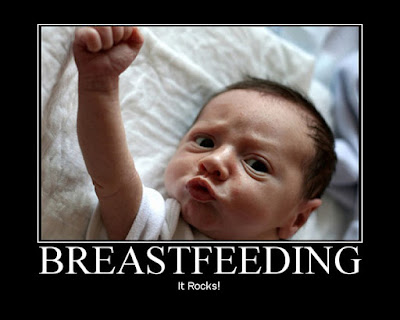
One final edit - I saw this just now and needed to share it!
Next time - Bedsharing!
When my first son was tiny and I was trying to get to grips with feeding him, I struggled. He didn't latch well, I felt awkward holding him, my arms ached from lifting him and holding him in position to feed, my nipples were sore, I developed mastitis, I felt self-conscious about exposing bits of wobbly postnatal belly when lifting my jumper, I leaked milk everywhere between feeds and from whichever side I wasn't feeding from at the time - never mind the fact that he CRIED. A lot. I was certain that there was something wrong with what he was being fed, either the quantity or the quality. Why else would he cry?? I remember loudly lamenting to my midwife that boobs really should be see-through and have little marks down the side to help keep track of how much milk babies had taken! Looking back now, I see that comment as sadly indicative of how far we've marginalised breastfeeding and normalised bottle feeding in its place.
It wasn't a snuggly and calm experience, and I thought I must be doing it wrong because it didn't feel like the pictures suggested it should. The remedy to this was chatting with a bunch of other breastfeeding mums I knew from baby groups and realising that we had all experienced varying degrees of discomfort and awkwardness, worry and frustration. I wasn't weird and certainly wasn't doing it wrong! That's just what it's like trying to learn a new skill when you're already tired and uncomfortable from having given birth days or hours before. Imagine trying to learn to drive when you haven't slept properly in days, then giving yourself a hard time for struggling to coordinate your hands and feet to control the vehicle!
So. This time would be fine for me, right? I've breastfed three other children for around a year each. I'm a trained peer supporter and have read an almost absurd amount of stuff about how breastfeeding works. So I wasn't going to have any problems getting to grips with feeding this baby... HAHA. How wrong was I.
The very first time I fed him was lovely. Ok so I may be remembering that through rose-tinted glasses. I was still very uncomfortable after the birth, covered in blood and sweat (I promised honesty!), still high from the pethidine and gas & air, starving hungry and really, really tired. But he latched like a pro and quite happily munched away for about half an hour while his Dad & I cooed over how beautiful he was. Later on when we had settled into the postnatal ward, I tried to feed him again. He promptly clamped his mouth shut and wanted nothing to do with me. "Alright", I thought, "that's fine. You've been born with plentiful fat stores to keep you going, you're probably a bit zonked from the pethidine. This isn't a problem". I held him and he went to sleep, so I lay down and snoozed for a while myself. Throughout the following morning I tried again to feed him, anxious to tell the midwives that he was feeding well so we could go home at some point that day. No matter what I did - all the tricks in the book about stripping his clothes off, tickling his feet, skin to skin contact, changing feeding positions - he wasn't interested. Even when we got home that evening, he didn't want to know. I was still reminding myself that this is ok, he was very awake and alert but just preferred to be held and look at faces.
Around midnight, something happened. I don't know what, but it's like someone flicked his 'hunger' switch on and peaceful snoozy baby morphed into Screaming Booby Monster. He fed and fed and fed and fed for three hours straight. I knew he wasn't latching properly, I could see that his mouth wasn't opening enough when I was putting him to the breast and I could feel that something wasn't right as I was feeding him but he was busy munching away and I didn't dare disturb him in case he resumed screaming. After 3 days, I was at the stage of toe-curling pain when he started feeding. Every now and then, I'd manage to get him to open his mouth really wide and the pain would be virtually non-existant for that feed, so I assumed that the issue was purely my laziness in getting him to latch properly and all I needed was to really concentrate on getting him to open his mouth wide enough each time and we'd be onto a winner. Oh, and to apply lashings of Lansinoh in between feeds. Not to digress, but I really do love that stuff, perhaps too much. I remember day five, waiting for family to come and visit and being in floods of tears because that particular morning he had fed solidly from 6am to 1pm without more than a few minutes break, and I felt like I was either going to lose my mind, or my boobs were going to fall off. I dreaded having to try and explain that he was just having a fanatical feeding day and I was fine with this, potentially having to field suggestions to maybe give him a bottle or justify why I didn't want to do that. Thankfully he mellowed out just as our visitors arrived and was mostly lovely company for the afternoon.
Through a series of clerical mishaps, we didn't see the midwife again until Baby T was 10 days old, at which point they weighed him and announced that not only was he back to his birth weight, but he'd actually exceeded it by a further 3 ounces. That was very exciting news to me and reassured me that although latching him on still hurt quite a bit (less so since I'd taken to smearing myself in Lansinoh!), he was clearly getting enough milk, so it was all worth it. I casually mentioned the discomfort to the midwife, but said I wasn't worried because he was gaining weight really well, had masses of wet and dirty nappies so everything must actually be going fine. She decided to check him over anyway and within seconds had spotted that he had a tongue tie. This was a relatively new concept to me as tongue tie wasn't as widely known about when I did my training or when my other children were babies. If you feel underneath your tongue, you'll find a tiny thin bit of flesh attaching your tongue to the bottom of your mouth. In babies with tongue-tie, that bit of flesh is too short and/or attached too far forward, preventing them from thrusting their tongues forward and thus latching on to the breast properly.
I can't tell you how thrilled I was when she said that to me. That may sound really ridiculous but I was starting to lose faith in myself. As I said before, I've breastfed three other children, trained in breastfeeding support and spend an inordinate amount of my spare time reading up on issues surrounding breastfeeding. Establishing breastfeeding with my own baby should have been a doddle! Admitting that I had sore nipples from a poor latch was pretty embarrassing to be honest, so being told that it wasn't my fault was music to my ears! Best of all, it was something that could be remedied! She rang the community midwives office to ask for a referral to our resident lactation consultant, who happens to be a bit of an authority on tongue tie, and I was astonished for her to then ask if we were available to pop in and see her the following morning for a consultation and possibly to have Baby T's tongue tie divided. That's pretty fast moving for any NHS procedure, but in the context of what I've read of other parents waiting weeks to see someone, battling to have a tongue tie properly diagnosed or even find a doctor who recognises that such a thing exists, this was absolutely monumental.
As the evening wore on, I started to feel nervous about the morning's appointment. The excitement had worn off, and instead apprehension about the idea of dividing his tongue tie crept in. It's a tiny, tiny procedure. It takes half a second at most and the staff who do it are very well trained. From what I'd read, it's less distressing to a baby than the standard heel prick test almost every baby in the UK has at 6 days old, or the vaccinations at 2, 3 and 4 months old. But still... something about the idea of anyone sticking a pair of surgical scissors into my baby's mouth to snip a bit of flesh... Well quite frankly the very idea of it brought me out in cold sweats. I prepared myself mentally to argue every which way against having it divided until I was absolutely certain that it was necessary and that doing so would improve Baby T's wellbeing.
The appointment was actually much less alarming that I'd convinced myself it would be. The midwife was lovely, very comforting but also straightforward and no-nonsense. She went through the assessment paperwork with us and explained how they determine the severity of a tongue tie in terms of how it impacts a baby's ability to feed. We also talked through how long and frequently Baby T had been feeding - not easy considering that I hadn't been paying attention and just fed him if he wailed! I pointed out that I was very reluctant to have the procedure done as my pain and discomfort was reducing through me really concentrating on getting his latch right, and he was clearly getting enough milk because his weight gain was really good. It wasn't until we looked again at his feeding pattern that I realised his weight gain was so good because I had probably spent about 70% of my time doing nothing but feeding him over the previous eleven days. Newborn babies are supposed to feed a lot; their tummies are tiny - walnut sized really - so they fill up quickly and also empty very frequently! I had simply put down his frequency and length of feeding to normal newborn behaviour, but actually from the midwife observing him feed, we could both see that he wasn't getting a lot of milk in one go, so needed to feed for ages on end to fill up. Closer examination of his mouth showed us that his tongue tie was actually pretty bad and he could barely move his tongue around - certainly not enough to ever be able to latch on properly to be fed. Although his weight gain had been great so far, that would most likely tail off quite quickly and he'd start to struggle. I didn't want to leave it until he was older to have the tie divided because it would be more distressing to him then, so we decided to go for it. I wimped out of holding him and asked my husband to take over while I got ready to feed him. The moment it was done, he squawked a little but he was handed back to me immediately and settled down to feed. I promptly burst into tears and gripped him fiercely but once I calmed down it dawned on me that I couldn't feel any pain from him feeding!
For the next couple of days, I carried on really concentrating on getting him to open his mouth wide and latch properly - the midwife had warned that he'd effectively need to re-learn what to do with his mouth now that he could move his tongue properly - but the real surprise was how much shorter his feeds suddenly were. Whereas I'd previously sit for half an hour or more to feed him, he would now either fall asleep or un-latch himself after something more like ten minutes. I haven't had him weighed again yet, but he's outgrown a handful of his first outfits and started to develop chubby cheeks and thighs.
Since having the tongue tie sorted, I've tried very hard not to worry about anything breastfeeding related. I'm no longer in pain, Baby T is most definitely putting on weight and becoming more alert and interactive, he's sleeping well (that's another blog in itself ;-) ) and is generally wonderful to be around. Aside from a couple of days feeling under the weather with mild mastitis, all has been much smoother for the last two weeks. The health visitor is coming again this Friday and will weigh him again so I'm looking forward to seeing how well the weight gain is going now - especially as there is a small part of me competing with a friend whose baby is the same age and is gaining weight like a professional!
If there is one thing I would hope an expectant mother to take from this post, it is to accept that the early days are not going to be a picnic - and that that's ok! Read lots, talk to other breastfeeding mums and health care professionals, but also accept that when you're sore, aching, exhausted and bewildered by a tiny, wailing creature for whose wellbeing and survival you are entirely responsible, all that preparation will go out of the window and even the most seasoned breastfeeder will falter without the right support at hand. Without the local midwives and lactation consultant really knowing their stuff and reaching out to offer me the help I needed, this last month would have been infinitely more troublesome than it has been. I think we've just about settled down now and I feel confident and comfortable with breastfeeding. Now all I have to sort out is my wardrobe! Finding summery tops that I can breastfeed in comfortably is harder than it sounds - particularly as 'comfortably' for me absolutely has to mean that I don't worry about flashing bits of wobbly belly at anyone. So far I've favoured the two layered approach with a vest top underneath a baggier top, so I'm exposing the minimum amount of flesh possible. That's fine while the weather is so grim, but if it warms up over July & August, I'm going to have to go shopping!
While I'm on the topic of breastfeeding, I'll take the opportunity to shout out to a few other blogs worth reading if you're a breastfeeding woman, or pregnant and want to read more:
For great tips on fashionable clothes and breastfeeding (because I'm still a girl and still love clothes!): Milk Chic Breastfeeding Fashion blog and website
For amazingly eloquent and stirring pieces on new research or responses to coverage in the media:
The Analytical Armadillo blog (from a certified lactation consultant)
For great info and more bare-bones truth about breastfeeding:
Dispelling Breastfeeding Myths blog
Edited to include the lovely Kim of the Little Leaf (I've just discovered her blog and am a little bit in love with it)
And a list of helplines from the NCT is available HERE
One final edit - I saw this just now and needed to share it!

Next time - Bedsharing!
Friday, 1 June 2012
My birth story, as promised!
I am delighted to announce that baby Theodore William was born at 11:46pm on Monday May 14th after a relatively short but intense labour! Many apologies for taking an age to blog again, but it turns out that tiny babies are really quite time consuming!
In keeping with the theme of my blog, I would like to share my birth story and relate it back to the pregnancy, birth and parenting philosophies I am so passionate about. One of my favourite other parenting blogs to follow is Birth Without Fear, primarily a collection of birth stories focusing on giving birth back to women as opposed to it being the highly medicalised, intervention-driven phenomenon we often see it as today. Although the majority of the experiences shared within are drug-free home births, there are also stories of caesarean section, hospital deliveries and birth following induction of labour. The focus isn't so much on "all natural" birth, but more about empowering women to feel in control of their birth, no matter what shape it takes. I have found over the last 7 years as a mother that it is very easy to have decisions taken out of your hands and governed by hospital policies and common medical practices, even if that doesn't fit with your own ethos and comfort zone. Rebelling against these practices can be very frightening, especially when you are essentially arguing with a highly qualified medical professional about what they do for a living. One of the most helpful tools I was given at antenatal classes in my second pregnancy was the B.R.A.I.N acronym to use when questioning proposed procedures during pregnancy and birth.
B = benefits What are the positive outcomes from this course of action?
R = risks What potential negative consequences are there?
A = alternatives What else could we do instead?
I = intuition What does my gut tell me about this?
N = nothing What happens if we do nothing now and let things continue as they are?
I used that when it came to my second son's birth and the result was a very calm labour during which I felt entirely in charge and had nothing but good feelings when looking back on it. Unfortunately I lost that grip when it came to the birth of my daughter two and a half years later, and wound up with a very frightening experience, with hospital staff intimidating me into accepting procedures that I didn't want (or, on reflection, actually need) and at one point going as far as making me cry. Coming to terms with that birth took me a long time, and I was determined this time to recreate the birth of my second son as much as I could. The details needn't necessarily be the same - I had a lovely drug-free water birth then, which was easy to arrange because I had no complications during the pregnancy at all. My logical head knew that things may not go the same way this time if I was at all unwell through the pregnancy, but the important thing when preparing emotionally to give birth again was to feel that the birth was MINE, not the midwife or doctor's; the decisions made about my care would come from what I wanted, not what I felt pushed into; and I wouldn't be afraid to challenge any proposals that I didn't feel comfortable about. Beyond that, I didn't have much of a birth plan. When the midwife asked me about it, my answer was simply that I wished to be left alone as much as possible and have as few interventions as I could.
And now for the confession part... My promise from 3 weeks ago was, after all, to be honest about how far my preaching lives up to my practices!
My birth this time didn't really go the way I wanted. It wasn't intervention-free, I wasn't relaxed and calm throughout and at times I was very frightened - too frightened to refuse having my labour induced or to articulate why I didn't want to be put on an IV drip to intensify my contractions later on. Everything I had practiced about B.R.A.I.N. and feeling in control of my labour went out of the window and I quite literally hid behind my husband at one stage!
Everything started on Sunday afternoon when my waters broke spontaneously and in epic fashion whilst I was folding laundry. That's never happened to me before so I was quite taken aback and not too sure what to do! I'd been experiencing bouts of contractions for weeks, although they always stopped after a few hours and I'd settled into a mindset of just not thinking about when labour might start. This was different though, because waters breaking means that labour is very imminent! According to the midwife, 60% of women go into labour within 18 hours of their waters breaking so I got very, very excited and called the labour ward. They asked me to come in and be checked over, which I did and then chatted about how things would go from here. They said that if I hadn't gone into natural labour by 8am the following morning, I should phone again to discuss induction. That's the first point at which I panicked. I've never been induced before... my labours have always started by themselves - two of them were before 40 weeks, so I have limited experience of going overdue at all. I have heard stories of induction though, none of which sounded very appealing, and from reading lots about the mechanics of labour, I understood that the artifice of inducing contractions meant that it would all hurt a lot more. Without the natural accompaniment of endorphins with the oxytocin release that governs natural labour, I would feel everything much more intensely. Bizarrely, that didn't fill me with much joy! I went home, determined to bounce around on my birth ball all evening, drink raspberry leaf tea 'til it came out of my ears, walk around as much as my achey hips would permit and eat the spiciest curry I could tolerate, all in the name of getting labour to start by itself! Did ANY of it work? Did it heck. Just as most nights of the preceding few weeks, I had contractions, they hurt quite a lot, they stayed regular and increased in frequency to every 8 minutes.... and then by 3am it all stopped and I cried. This time I cried because I knew the next day would bring a lot of examinations and procedures I didn't want, and would most likely culminate in me having the sort of labour I'd been afraid of all along.
At 8am I rang the labour ward as discussed and was advised to call back again at 11am to arrange a time to go back in. I tried to stay calm all morning and discussed my feelings with my husband, reminding him in particular that I remembered how much the Fear had affected my last labour and how much I regretted the epidural I had begged for when the midwife snapped at me and told me I'd be labouring for hours and was putting my baby at risk by refusing more interventions. I told him that I needed him to be my advocate this time, that if things went the same way and I couldn't cope, that I would need him to make me question myself if I started to waver on my faith in myself: "Remind me how much I hated the epidural, don't let me beg for one again". I googled frantically, rang midwife friends, posted on the Analytical Armadillo's facebook wall - all to find out as much as I could about what induction of labour would involve and what I needed to know about my alternative options. What I learned was reassuring - namely, I could go as far as refusing the induction and waiting up to a further 72 hours for labour to start spontaneously. The NICE guidelines accommodate that and have advisements in place for how to monitor pregnant women for any sign of infection which would indicate an urgent need to get the baby out. That appealed to me a lot more than having pessaries inserted or being hooked up to IV drips! The thought of being able to retrieve my natural labour after all calmed me down and we toddled off to the hospital to talk to the midwives.
Something very strange happens to me when I enter a hospital building. I'm not in my house anymore... I'm in the doctors' house. This is their territory, not mine. I have no right to question their opinions with my own amateur knowledge informed by Google and entry-level Biology textbooks. It might be hard to believe, but my bolshy-ness does a complete runner and in place is a meek and frightened girl, not a strong and determined woman. So I sat in the delivery room, pondering what would happen and trying to scramble together my recollections of the information I'd gathered that day.
A lovely, lovely midwife came into the room and we started talking through the various paths ahead. She was smiley and reassuring, matter of fact in answering my questions and respectful of my worries. I don't recall exactly how, but the decision I made was to accept the induction there and then, not wait for the next 72 hours to pass then reassess. I'm aware that I felt apprehensive about deviating from the hospital's usual practice and defying the wishes of my - albeit lovely - healthcare professional. Without a team of like-minded people physically around me, urging me to push forward with me desire not to be interfered with, I'm afraid I didn't have the inner strength to go against the grain. It was a mixed feeling... on the one hand, happy to be a step closer to meeting my baby, at the same time deflated at my birth no longer being "mine" but instead morphing into the property of the doctors, to be assessed and evaluated according to their rigid checklist of events that would determine whether or not the progress I made over the coming hours was to their satisfaction.
The midwife explained that step one would involve inserting a pessary containing synthetic prostaglandins to help my cervix soften and begin to dilate. Hopefully this would be all that was needed to get labour going into full swing, but if not I would then be given an intravenous drip of more synthetic hormones intended to either start contractions or to make existing ones stronger. If that happened, I would need to be hooked up to a machine to have my baby's heart rate constantly monitored, and this would ideally take place with me lying down... for the entire duration of my labour. THAT completely freaked me out. I don't *do* lying down in labour. The geography of it just doesn't work! Forget everything you've seen on tv - labouring lying down is the least convenient position for a baby to try and exit the womb. The birth canal slants in such a way that you would end up trying to push the baby out uphill, all the while with the weight of said baby pressing back against you, limiting your blood flow through the arteries running along your spine. ICK. No way, Jose. I've done that once in my first labour when I didn't know any better and it was evil. Furthermore my son then needed to be resuscitated after the birth, something I'm confident wouldn't have happened if I'd been in a better position when labouring and pushing.
With fingers crossed and prayers said, we toddled off to the antenatal ward to wait for the pessary gel to take effect and hopefully get labour moving. I sent my husband home at this point to see our other children because I didn't think there was much point him mooching around the ward waiting for something or nothing to happen. I had my tens machine (borrowed at the eleventh hour from a friend!), Jaffa cakes, birth ball and - most importantly - the whole bay to myself! Six beds on the ward and none occupied. I was very relieved to have a big open space to myself, so I set about bopping on the ball, snacking to get some energy back and chatting to the two student midwives who were pottering around. After a very short while, the contractions ramped up and I was confident things were moving as I'd prayed for. Two hours after the gel had been done, the senior midwife on the ward started to flap a bit and asked if I'd like to be examined to see if I'd progressed and should be moved back to the delivery room. I was ok with that (more anxious to know if all the pain was finally getting me somewhere!) so they checked me over and cheerfully announced I'd reached the magical 4cm dilated which indicated I was now in Active Labour. This was it, all hands on deck, no going back now - and more importantly, I had escaped the dreaded IV drip. The thought occurred that I should probably call my husband to come back to the hospital as we had originally agreed that he wouldn't return until after our kids were in bed, but the midwife and I suspected things may be moving faster than that!
When we got back to the labour ward, husband dutifully in tow, I met with the midwife who was to care for me throughout the rest of my labour and the birth (assuming her shift didn't end first anyway!). I wasn't sure if I liked her to start with... She was very pretty, beautifully made up and quite glamorous looking. When you're in the throes of labour and feeling at your least dignified, it smarts to see someone looking lovely at you! Fortunately she was absolutely delightful, made me giggle and put me at ease. We were furnished with a radio to listen to Classic FM, jugs of ice water to keep me refreshed (although my husband qualified for several cups of coffee throughout the evening, hmmph) another birth ball and extra pillows so I could experiment with moving around and getting comfortable. At this point, I felt fantastic... I had defied the doctors' expectations by responding so quickly to the induction, I was in control of my labour, I was mobile, lucid and very excited about meeting my baby soon. My husband took a photo on his phone of me beaming with the gas & air pipe in one hand and a cup of water (held aloft like a chalice of fine wine!) in the other, and sent it to my Mum, who had been fretting about how I was coping. The pain increased and my contractions were 2 minutes apart from here on in. I leaned on my husband for support, taking great comfort in burying my head in his shoulder whilst standing on my tip toes (goodness knows why that was more comfortable than just standing!), pressing the BOOST button on the tens machine and going for gold with the gas and air. I had tried the ball, kneeling on the bed, leaning on pillows etc, but everything other than standing upright was unbearable agony.
I had last been examined just after 6pm, so the midwife said they would check again around 10pm if I consented. By 9pm, I was certain I felt the sort of pressure that indicated being ready to push, so we decided to check again and see how things had gone. My heart sank when she paused before telling me I was still only 4cm. After 3 hours of utter agony, nothing had happened. My body wasn't cooperating with me after all. Weeks and weeks of slow latent labour, of promising myself that it would mean that, when the time came, the groundwork would have already been done and the birth would be smooth sailing, then gradual realisation that my body and I were no longer in tune. All that pain and frustration just to get my hopes up for those few hours in the delivery room, only then to feel utterly crushed and like we were back at square one. To add insult to injury, the midwife then had to break the news that she was duty bound to inform the doctors of the outcome of the examination, and that they would certainly press for me to have the drip to intensify the labour. At that point, I had a complete meltdown. The idea of making an already unbearable labour more intense after taking away the faith I had only just restored in my body... I'd felt that Fear before, in my last labour. I had had maybe 10 hours sleep in total that entire week and didn't have the energy to deal with the pain any longer. I felt the words "please, please make it stop" leave my lips before I burst into tears and begged for them to call the anaesthetist. If I was going to be labouring for hours, I may as well lessen the pain. The labour wasn't mine anymore anyway. The doctors would shortly be arriving to take over and mould it into THEIR delivery, according to their specifications of how a labour should progress. Why should I fight and embrace the pain of a labour that didn't belong to me.
As he'd promised that morning, my husband started to remind me how I felt last time after the epidural - that I had regretted it instantly, that I mourned the pain from the birth because I no longer felt it, that my daughter had been born half an hour after it had been administered so I always felt that it had been a pointless intervention. The midwife stepped in and held my hand. After that contraction passed and I was back in the room, she talked to me about what my husband had said. I expected her to come down on the side of knocking me out, but to my amazement she really took on board how I had felt last time and started talking me through other ideas. She suggested pethidine as an interim measure, saying that at the least it would relax me a bit and stop me panicking. If we were lucky, I may even be able to sleep a little while and regain some energy to face the rest of the labour. I fell in love with her a little when she then also promised that she would do her best to fight my corner and delay the doctors putting up the IV drip to give me time to get back in control. I was reluctant to accept the pethidine because I had had it in my first labour and felt very sick, but by this stage I knew I needed to make A decision and regain my control, so I told her to get it over and done with before I changed my mind.
After that, everything is a blur. I vaguely remember stripping off the gown I'd put on over my vest earlier in the evening and climbing up onto the bed. The next thing I recall is the final two pushes before my son was born, and then leaning face down into the pillow for a couple of minutes asking myself if that really was it, was it really all over! The midwife then pointed out that it had only been 25 minutes between the pethidine injection and me getting into position to push! I had gone from just 5cm dilated with half my labour still to go and in absolute emotional breakdown, to pushing my baby out in less than half an hour! I remember murmuring "is it really over?" half a dozen times and feeling incredibly relieved that the pain had finally stopped. Even so, I really didn't want to let go of the tens machine controls! It had become such a comfort to me that I needed to hang onto it for a few moments until it really sank in that the hurty bit was done with. In truth, I felt a little shell-shocked. I hadn't expected such a managed birth, or to feel so frightened and small especially as this was my fourth birth and I've researched so much about relaxed birthing techniques!
So that was it. It didn't go the way I had wanted, but I can say that I felt in tune with my midwife and that she respected what I was trying to achieve with my birth and did everything she could given the circumstances. It's difficult to say out loud that your birth didn't go to plan, because very often people's response is to say that it shouldn't matter because you still have a healthy baby from it. Actually, it DOES matter. Can you imagine responding to a crestfallen bride on her wedding day that it didn't matter that everything had gone wrong on the day because she still had her husband out of it? We afford women the right to demand their perfect wedding day and we should do the same for their perfect birth, and moreover we should accommodate women needing to work through the barrage of emotions that comes around if they wind up with a birth that feels completely alien to them. I have been offered the Birth Afterthoughts service from my midwife since being discharged from hospital, which I declined because writing everything out here has been therapeutic enough and I feel at peace with how things went now. I know women who've had really traumatic births though and who still need a lot of support to deal with that.
I won't be having any more children but all my experiences of childbirth have reinforced my passion for giving birth back to women, empowering women to feel in charge of and in tune with their own bodies and not to feel afraid of the frankly awesome things we do whilst bringing new life into the world.
Quite frankly, we women rock!
So that was it. It didn't go the way I had wanted, but I can say that I felt in tune with my midwife and that she respected what I was trying to achieve with my birth and did everything she could given the circumstances. It's difficult to say out loud that your birth didn't go to plan, because very often people's response is to say that it shouldn't matter because you still have a healthy baby from it. Actually, it DOES matter. Can you imagine responding to a crestfallen bride on her wedding day that it didn't matter that everything had gone wrong on the day because she still had her husband out of it? We afford women the right to demand their perfect wedding day and we should do the same for their perfect birth, and moreover we should accommodate women needing to work through the barrage of emotions that comes around if they wind up with a birth that feels completely alien to them. I have been offered the Birth Afterthoughts service from my midwife since being discharged from hospital, which I declined because writing everything out here has been therapeutic enough and I feel at peace with how things went now. I know women who've had really traumatic births though and who still need a lot of support to deal with that.
I won't be having any more children but all my experiences of childbirth have reinforced my passion for giving birth back to women, empowering women to feel in charge of and in tune with their own bodies and not to feel afraid of the frankly awesome things we do whilst bringing new life into the world.
Quite frankly, we women rock!
Friday, 11 May 2012
*THAT* Time Magazine cover...
How could I not blog about it? I mean really... Everyone and their dog seems to have an opinion on Time's May edition front cover photo and it seems to have caused quite the whirlwind. Never one to resist a good bandwagon, I feel it's only polite for me to contribute my two-penneth on the matter.
You can't possibly have missed it, but just in case you have, here is the image in question:

The lady is 26 year old mother of two, Jamie Lynne Grumet from Los Angeles, and the child is her near-4 year old son, Aram. So there's the introductions done with: Jamie and Aram, meet the world. The world, meet Jamie and Aram. OH! But wait... I forgot the pivotal character in this photograph - Jamie's BREAST. And oh my word, look where it is! Aren't we all just shocked to our very core? No? Oh... No, neither was I. It's a woman, breastfeeding her son. That's it. I have no reaction to it beyond that. I've known plenty of mothers and children who've enjoyed breastfeeding up to and beyond 4 years of age and it's just one of the many things that some parents and children enjoy doing together and others don't.
There is, however, something I really, really don't like about the magazine cover. That caption... right there... Are You Mom Enough? Ick, yuk and shudder. I'm not even sure where to begin with dissecting this one. Firstly, every woman who has ever been pregnant is a mother. One-hundred per cent. There aren't degrees of motherhood, there isn't a checklist of achievements and activities that you tick off and at the end there's a shiny medal. I don't care how or whether you gave birth, how you fed your baby, where your baby slept, how you transported him or her around - we are all 100% mothers and should support and care for each other in that. There are plenty of parenting choices that I don't like and wouldn't practice myself, some that actually upset me a little because of the reasoning behind them or research demonstrating potential long term negative effects - but I am no "more" a mother because I of the things I do or don't do with my children. It just isn't a competition.
The juxtaposition of that dreadful, loaded question with the image really sets up attachment parenting as the sort of movement that DOES consider parenting to be a competitive sport though. It's no wonder that the general public see us as weird, yoghurt-knitting hippies with superiority complexes because we practice x, y and z. I made the terrible mistake of reading comments from the general public on a range of websites that had written about this issue over the last couple of days, and some of them really made me incredibly sad. The vitriol directed at attachment parenting and the people who practice it is intense in places. Allegations of child molestation and paedophilia, accusations that this sort of parenting produces dependent, slothful adults who don't know how to function, and the favourite "it's all for the mother's selfish benefit". Selfish? Child abusers?? That hurts. It's also untrue but that should be obvious anyway - right? Well here's the problem... The mass media LOVE a juicy contentious issue to whip the public up into a bit of moral outrage. It sells, it's sexy news. I have never read or even considered Time Magazine before (I don't think it's a big thing here in the UK anyway) but here I am writing about it having spent a lot of today reading what other people have written about it. So clearly it's NOT obvious that we're not all judgmental lunatics.
Actually if you go out and meet the sorts of women who breastfeed their children to whatever age, share a bed with them, use a sling or carrier more often than a pram or stroller, you'll find that, on the whole, we're really very ordinary. In fact, I defy anyone to single out one parent in their entire social circle who has not, at some stage, either breastfed (even only once after birth), slept in the same bed as their baby (even just one night out of sleep-deprived desperation!) or carried their baby in a sling of whatever design.
Very few of us are bonkers and self-righteous - naturally a few are, but then you find bonkers, self-righteous types in all walks of life! Just because some people who prefer bed-sharing, breastfeeding and baby-carrying are a bit nuts, this doesn't automatically mean that ALL parents who adopt this approach to raising their children are funny in the head. Somehow the sweeping generalisation that we are seems to have become the normal perception of attachment parenting, and sadly coverage like the Time magazine front cover really only serves to fuel that misconception.
Reading an interview with the lady in the photograph, something jumped out at me about her appreciation of Dr. Bill Sears - the man credited with pulling together the philosophies behind attachment parenting and shaping it into a defined 'style' of raising children. When asked if she was a fan of his, Ms. Grumet replied that she finds him to be "a gentle spirit... nonjudgmental and relevant... The way he does it is graceful and educating rather than condemning"
That's a perfect summary of how I feel we should all treat one another in our journey as parents. It's what attracted me to join support groups for attachment parenting and why I enjoy reading the blogs and books written on the subject. I have encountered judgment and condemnation, but as a recipient from those who don't understand what my parenting choices are about, because they have chosen not to educate themselves about it but instead to make assumptions gleamed from snapshots misrepresenting the whole area - rather like this magazine cover. Or like the Channel 4 documentary on "Extreme Breastfeeding". Or like the plethora of Daily Mail articles maligning parents and particularly mothers at any given opportunity... You get the idea. It is very difficult to find a piece of popular media that presents attachment parenting or any of its constituent elements in a positive and open-minded light. In fairness, why would they? It's not interesting if you talk about it sensibly and encourage people to make up their own minds. It sells FAR many more issues if you get people really riled up, set parents up as warring factions hissing and spitting at one another's choices. Throw in some really obtuse reference to sex and you're onto a winner!
So there is my opinion on the debacle. The fact that the woman in the picture is breastfeeding a four-year old is neither here nor there. I'm far more concerned by the unfortunate message that is being given out about attachment parenting and the people who embrace it.
Thursday, 10 May 2012
So it's my due date!
Aaaand I'm still pregnant. It's not that big a deal, most babies are born after their due date anyway (makes you wonder why we bother with them!). I'm a little dismayed simply because two of my other children were born in the days leading up to the due date and I've had so many false starts in the last couple of weeks, we've been on edge and ready for Baby Alert for ages.
I did promise in my last post that I would keep an honest and open diary about my experience of having a new baby, so this seems like a good place to start. How I feel about going overdue... I would love to say that I'm on board with the barefoot hippy mentality that knows my baby will be born when he's good and ready, and not before. I actually know women who are not only perfectly happy to go beyond the 40 week mark, but actually object on principal to any medical intervention that would bring on labour artificially. Man, I would LOVE to have that sort of outlook and faith in my body. It's not that going overdue frightens me... I have every confidence that my body will look after my baby until he's ready to deal with the outside world. I'm just really bloody uncomfortable and running out of patience now!
I have armed myself with the plastic smile and stock answer of "yes I'm fine, just very excited" ready for when people ask me how I'm feeling. I'm not fine and excited is not the number 1 emotion I'm feeling at the moment, but I have learned that when people ask a heavily pregnant women how she's feeling, they don't actually want to be told that you're sick of swollen ankles, piles, sleep deprivation, heartburn, constant loo visits, not being able to see your own foof to keep up personal grooming and so on. If anything, it seems to invite responses like "ahh but you're lucky really because so many women can't get pregnant at all", or even "you'll get no sympathy from me, this is all self-inflicted!" (this was genuinely said to me a few days ago). So, the next time someone asks me how I'm feeling at 9 months pregnant whilst running round after 3 small children, I will tell them that I'm fine and very excited about meeting our latest family member.
I will confess now to obsessively watching my moods and changes in my body for anything that indicates impending labour. Apparently a strong desire to clean the house coupled with an inexplicable irritability at everyone and everything is a dead giveaway that I'm about to give birth. Well... I clean all the time because I have 3 children and a very messy husband. If I didn't clean all the time, my house would be revolting! I'm grouchy because I'm heavily pregnant and have to spend all my free time cleaning my house! So I don't think I can trust those two 'signs'... Every little cramp and twinge I get is carefully analysed so I can decide whether that was a strong Braxton Hicks (sort of like a contraction but just a practice one) or a very mild proper contraction, and then timed to monitor regularity and increases in frequency. I'm not going to talk about going to the loo.. I know, I know I promised honesty, but the women who've done pregnancy and childbirth before will know where this is going, and those who haven't really don't want to know. I will leave you with one word that says enough: mucous. There, be glad that I'm not going into more detail!
So you can tell that I'm definitely NOT in line with the super-relaxed barefoot hippy momma philosophy just now. I want this baby out, sooner rather than later. I want my body back! I want to be able to put my jeans on without enlisting my husband's help. I would very much like to be able to reach my ankles when I shave my legs. I'd really, really like to be able to get off the sofa without having to rock back and forth to gain momentum, like a tortoise stuck on its back (a source of great amusement for friends and family last weekend!).
But... I Am Fine And Very Excited. Honestly.
Next: my birth story (whenever it flipping well happens!). Will I get my intervention-free, drug-free water birth? Or will I end up flat on my back at the midwife's insistence and begging for an epidural?
I did promise in my last post that I would keep an honest and open diary about my experience of having a new baby, so this seems like a good place to start. How I feel about going overdue... I would love to say that I'm on board with the barefoot hippy mentality that knows my baby will be born when he's good and ready, and not before. I actually know women who are not only perfectly happy to go beyond the 40 week mark, but actually object on principal to any medical intervention that would bring on labour artificially. Man, I would LOVE to have that sort of outlook and faith in my body. It's not that going overdue frightens me... I have every confidence that my body will look after my baby until he's ready to deal with the outside world. I'm just really bloody uncomfortable and running out of patience now!
I have armed myself with the plastic smile and stock answer of "yes I'm fine, just very excited" ready for when people ask me how I'm feeling. I'm not fine and excited is not the number 1 emotion I'm feeling at the moment, but I have learned that when people ask a heavily pregnant women how she's feeling, they don't actually want to be told that you're sick of swollen ankles, piles, sleep deprivation, heartburn, constant loo visits, not being able to see your own foof to keep up personal grooming and so on. If anything, it seems to invite responses like "ahh but you're lucky really because so many women can't get pregnant at all", or even "you'll get no sympathy from me, this is all self-inflicted!" (this was genuinely said to me a few days ago). So, the next time someone asks me how I'm feeling at 9 months pregnant whilst running round after 3 small children, I will tell them that I'm fine and very excited about meeting our latest family member.
I will confess now to obsessively watching my moods and changes in my body for anything that indicates impending labour. Apparently a strong desire to clean the house coupled with an inexplicable irritability at everyone and everything is a dead giveaway that I'm about to give birth. Well... I clean all the time because I have 3 children and a very messy husband. If I didn't clean all the time, my house would be revolting! I'm grouchy because I'm heavily pregnant and have to spend all my free time cleaning my house! So I don't think I can trust those two 'signs'... Every little cramp and twinge I get is carefully analysed so I can decide whether that was a strong Braxton Hicks (sort of like a contraction but just a practice one) or a very mild proper contraction, and then timed to monitor regularity and increases in frequency. I'm not going to talk about going to the loo.. I know, I know I promised honesty, but the women who've done pregnancy and childbirth before will know where this is going, and those who haven't really don't want to know. I will leave you with one word that says enough: mucous. There, be glad that I'm not going into more detail!
So you can tell that I'm definitely NOT in line with the super-relaxed barefoot hippy momma philosophy just now. I want this baby out, sooner rather than later. I want my body back! I want to be able to put my jeans on without enlisting my husband's help. I would very much like to be able to reach my ankles when I shave my legs. I'd really, really like to be able to get off the sofa without having to rock back and forth to gain momentum, like a tortoise stuck on its back (a source of great amusement for friends and family last weekend!).
But... I Am Fine And Very Excited. Honestly.
Next: my birth story (whenever it flipping well happens!). Will I get my intervention-free, drug-free water birth? Or will I end up flat on my back at the midwife's insistence and begging for an epidural?
Sunday, 29 April 2012
A promise...
If you've been reading my blog for a while, or if you know me in real life, it can't have escaped your attention that I'm very passionate about my parenting choices and the philosophy behind them. I have often heard it said that it is much easier to preach than to practice, and I agree this is almost entirely true of parenting - even for those who have done this, that and the other. Looking back with rose tinted glasses at my journey through intervention-free birth, breastfeeding, bed-sharing, gentle discipline etc. I'm very certain I've edited out the parts where I doubted myself, where I maybe even thought I was a fool for not doing what the books said in the name of maintaining some semblance of a pre-baby identity.
And so here is my promise: as I am currently 38 weeks pregnant with baby no.4 and have every intention of following all this stuff I blog about and talk about incessantly, I will also endeavour to keep as honest a diary of this experience as I can. I will not hold back on talking about the difficult parts, I will not censor myself and romanticise what I do in order to make it seem more appealing to others. This may mean that sometimes I write uncomfortable truths - uncomfortable for myself to admit in a public domain and for others to read without judgment. I talk a lot about transparency and the need for expectant parents to have realistic ideas about life with a new baby, and so I offer up my no-holds-barred, warts 'n' all stories.
Can I actually practice what I preach and embrace it as joyfully as my memory likes to tell me I did previously? We shall see....!
And so here is my promise: as I am currently 38 weeks pregnant with baby no.4 and have every intention of following all this stuff I blog about and talk about incessantly, I will also endeavour to keep as honest a diary of this experience as I can. I will not hold back on talking about the difficult parts, I will not censor myself and romanticise what I do in order to make it seem more appealing to others. This may mean that sometimes I write uncomfortable truths - uncomfortable for myself to admit in a public domain and for others to read without judgment. I talk a lot about transparency and the need for expectant parents to have realistic ideas about life with a new baby, and so I offer up my no-holds-barred, warts 'n' all stories.
Can I actually practice what I preach and embrace it as joyfully as my memory likes to tell me I did previously? We shall see....!
Tuesday, 20 March 2012
Discourse Theory and Parenting - Deconstructing the Social Construct
For this post, I will don my amateur anthropologist hat (it's a pink sombrero if you're interested) and attempt to examine how the social phenomenon of "Parenting" (the capital P is important) has been shaped by the language we use to discuss it and how this influences the decisions we make about raising our children.
Before we get our teeth into the subject matter, I'd like to define a few of the terms which will crop up here and there. This is purely because today's post is written from an Anthropological perspective, which is great if you're an Anthropologist and understand the social theory behind my ideas. If you've never even glanced over them, however, they just don't make sense! It took me a while to get my head around some of the themes and perspectives I studied during my degree.
- Discourse theory - specifically "discursive formation" as outlined by Michél Foucault. The essence of this is that the language surrounding an idea is itself an integral element of its construction. Everything abstract exists as a product of the exchange of thought processes which created it.
That still sounds like complete nonsense, doesn't it? Yeah, I thought so too. Let's look at it in practice. Teenagers didn't exist pre-World War Two. Obviously they did exist, in that there were living people aged between 13 and 19 but they weren't "teenagers" as we know them today. The modern teenager - in his scruffy clothes, obnoxious attitude, untidy bedroom and general misanthropic outlook has been entirely constructed by post-war social ideas. Prior to this, adolescents were miniature adults, often out working, rarely in school past the age of 14 (in the case of working class families) but the idea of hormone-ridden, juveniles skulking round the streets in hooded tops and trainers just wasn't there in any form (further reading: Language, Class & Identity - Teenagers Fashioning Themselves Through Language)
It is the exchange of concepts through dialogue that shapes such a social phenomenon as The Teenager. The word 'teen age' (adj) itself first appeared in writing in a Canadian publication dated 1921, but was enclosed in quotation marks, signifying that it wasn't a fully integrated entry into the dictionary or normal language. From the late 1940s and early 1950s, "teen-age" began to appear in newspaper articles and was eventually included in the Oxford English Dictionary in 1950-something (I will find an actual date for that at some stage, promise!). Don't even get me started on "emo"!
George Orwell exploited this idea of the power of language and how it shapes concepts in his novel 'Nineteen Eighty-Four'. In the text, he creates "Newspeak" and "Doublethink" (combined in later linguistic theory to form "doublespeak"), which are effectively the two ways in which 'Big Brother' and 'the Party' have reduced the English language right down to a skeleton form; words have simply been removed from the lexicon in order to extinguish the concepts which they represent. In practice, this would mean that by removing the word "revolution" from the language, it ceases to exist as an idea and thus there can be no social uprising against the government. Doublethink is the mental process accompanying the implementation of Newspeak, in which the user is simultaneously aware that the truth has been altered and that the 'new' truth is now the only truth. If you haven't read 'Nineteen Eighty-Four', you really should. It's an excellent insight into how we use language.
Anyway, I digress. The point is that there are lots of ways in which you can explore the role of language and discourse in forming, sustaining and eliminating social phenomena.
Are you still with me? Well done! Now for another one...
- Cultural/social construct - this isn't dissimilar to how I've defined discourse theory. It's another expression of how events and phenomena only exist as a product of the exchanges which have defined them and characteristics that have been attributed to them. This extends beyond the language (discourse) though and looks at social norms and values, shared understandings across social groups.
Again, to put it into practice - gender roles are a cultural construct, as opposed to being innately defined by our biology. "Gender" is obviously a biological fact - a person's DNA will either express them as being Male or Female, but how that is expressed throughout their social lives is constructed BY the society in which they live. There is nothing in my biology which says that I, as the woman, must take charge of the housework in our home while my husband goes out to work - but this is the expected norm because my role as a woman has been decided by shared understandings, passed on from one generation to another. A 'stay at home dad' is regarded as quite the exception, because it goes against the cultural construct of the man's gender role.
Got me? That one is a bit easier to get your teeth into. Just beware of trying to apply it to more abstract scenarios... I recall having an argument with one of my lecturers because he said that Science is a social construct. He did persuade me eventually, but the depth of the theory to explain it was so elaborate that I've never been able to recall it since. Safe to say, pretty much everything is a cultural construct.
So those are the two biggest themes that will come up in today's post. As I said, you can break just about anything down as being a cultural construct - including Parenting.
You don't have to look far to see parenting in practice as a social event. Comedians will base whole routines around their experiences as a mother or father, there are websites set up with the express purpose of attracting mothers (and fathers, but more so the former) to discuss elements of their child-rearing, adverts for various household products and brands will often refer to "Mums prefer this" as a point in their superiority over competitors (my Asda loo roll promises me that 3 out of 4 Mums prefer it to the leading brand). Parents are a Big Deal in modern British society. The industry behind pregnancy, birth, baby care, childhood is enormous - at present I don't have even a ballpark figure for how much the UK baby industry is worth, but it is A Lot. Parenting is also a contentious issue in the media. Barely a day goes by when some news story or other doesn't come up about the impact of children's upbringing on their functionality as adults, whether it's behavioural, nutritional, medical - there is almost always something in the news about all the new stuff researchers are learning about how we develop from infants.
There is a huge number of phrases most parents will be familiar with, and each one is an idea entirely constructed by society:

Babies, as we know them in the modern context, are a social construct. I promise that is not complete nonsense! Biologically, we produce offspring. Humans are a mammalian species who give birth to live young (rather than laying eggs, etc) and provide their first nutrition in the form of milk from the mother's breasts. That is how science has differentiated mammals from reptiles, birds, insects etc. However, a chimpanzee baby and a human baby have very different roles within society. I can't recall any zoological studies investigating the sleep patterns of 12 week old baby chimpanzees, or groups of chimpanzee mothers coming together to discuss when they plan to start introducing solid food to their young one's diet. That sort of preoccupation is very much a human practice, and even more so in the last 50 years than earlier in history.
Why?
Why, if we're just another mammal, do we get so caught up in how we raise our children and all the possible combinations of consequences that decisions about this, that and the other might have?
I have some ideas about why, and it is all down to how human society has constructed The Baby. In the West, a newborn baby is a helpless, feeble, dependent being, reliant entirely on its parents for sustenance, warmth, protection and love. It is the job of the parents to enable this little creature to survive and to endow it with the ability to function as a biological entity, independent of its parents. The word "independent" is highlight in red there, because that is the fundamental point of Western parenting. Our focus is very much on assisting our babies to stop needing us as soon as is safe for them. Discourse about feeding babies often focuses on the baby's dependence on the mother as a negative of breastfeeding, or the ability of any other person to feed the baby as a positive of bottle feeding; we have the most bizarre obsession with how long our babies sleep at night and WHERE, with the self-proclaimed experts extolling the virtues of an infant learning to sleep alone as early as possible; behavioural observations will comment on making a baby 'clingy' if he or she is picked up and soothed every time a cry is uttered, and there are an increasing number of methods populating the book shelves claiming to teach your baby how to "self-soothe".
The outcome of all this is that parents begin their life with a new baby thinking almost from the word go about how and when their child will be less reliant on them to meet their every need. It has spawned a counter-revolution of parenting philosophies which rebels against this yearning for independence and calls itself "attachment parenting", with the emphasis on continual physical contact with a baby through breastfeeding, carrying the baby in a sling rather than a pram, bedsharing where safe to do so and so on. Ironically, these are the sorts of practices which invite the "rod for your own back" and "clingy baby" remarks and prompted me to write this blog in defence of my own choices.
For a moment, let's compare this to Japan. I read a fascinating article examining maternal and infant interactions in Japan and from it gleamed that The Baby as a social construct is a very different creature there than it is in the West. For them, The Baby is from birth an autonomous being and must be taught how to form relationships with other humans through ongoing contact from the parents. The social norm is much more in favour of maximised contact between the mother and baby, habitual bedsharing rates are infinitely higher as are breastfeeding statistics. Two groups of human beings, viewing and behaving towards their offspring in remarkably different ways, and all can be traced back to socially constructed ideas and how they are represented through the discourse surrounding parents and parenting.
I follow quite a few parenting blogs and their pages on Facebook, and there is a definite reoccurring theme among the posts from other readers. They are almost all related to how they feel they are negatively viewed and treated by other people for the choices they have made - this may manifest as being criticised for breastfeeding in public, well-meant but ultimately unwelcome 'advice' from relatives, observations about a baby's weight/sleep/general demeanour as a negative consequence of some choice made by the parents. I challenge you to find a single parent who does not feel that at some stage they have been criticised, however subtly, for a decision they have made about caring for their child.
So this is what we as a society have achieved: we have elevated the status of parenthood and parenting by creating a lucrative industry behind it, supported that status by revering the Mother and Father figure as paradigms of virtue in advertising of the most benign products and yet also constructed such an unnatural and inaccessible ideal of The Baby that your average man and woman waiting to welcome their first child will find themselves overwhelmed with conflicting advice as to what is "the best" thing to do.
You don't have to look far to see parenting in practice as a social event. Comedians will base whole routines around their experiences as a mother or father, there are websites set up with the express purpose of attracting mothers (and fathers, but more so the former) to discuss elements of their child-rearing, adverts for various household products and brands will often refer to "Mums prefer this" as a point in their superiority over competitors (my Asda loo roll promises me that 3 out of 4 Mums prefer it to the leading brand). Parents are a Big Deal in modern British society. The industry behind pregnancy, birth, baby care, childhood is enormous - at present I don't have even a ballpark figure for how much the UK baby industry is worth, but it is A Lot. Parenting is also a contentious issue in the media. Barely a day goes by when some news story or other doesn't come up about the impact of children's upbringing on their functionality as adults, whether it's behavioural, nutritional, medical - there is almost always something in the news about all the new stuff researchers are learning about how we develop from infants.
There is a huge number of phrases most parents will be familiar with, and each one is an idea entirely constructed by society:

Hands up if you've heard these before? (you don't really have to raise your hand, I won't see it anyway)
They are all ideas about modern parenting that crop up time and time again in the literature and general conversation between mums & dad, health care providers and self-styled "baby experts". Some of them relate to behaviours we anticipate our offspring to exhibit at certain stages (like sleeping for a particular number of hours overnight), some refer to the DREADFUL consequences of making certain choices about how to raise our children (I have an impressive collection of 'rods for my back' according to some people). And then there's this one: 'a happy mum means a happy baby' - this one induces the sort of head-meets-desk response from me; it's overly simplistic, thoughtless and frankly just not true! (read more HERE)
One thing that all these buzz words have in common is that they are entirely derived from Western social concepts about how babies ought to behave and how parents ought to achieve this arbitrary standard.
Babies, as we know them in the modern context, are a social construct. I promise that is not complete nonsense! Biologically, we produce offspring. Humans are a mammalian species who give birth to live young (rather than laying eggs, etc) and provide their first nutrition in the form of milk from the mother's breasts. That is how science has differentiated mammals from reptiles, birds, insects etc. However, a chimpanzee baby and a human baby have very different roles within society. I can't recall any zoological studies investigating the sleep patterns of 12 week old baby chimpanzees, or groups of chimpanzee mothers coming together to discuss when they plan to start introducing solid food to their young one's diet. That sort of preoccupation is very much a human practice, and even more so in the last 50 years than earlier in history.
Why?
Why, if we're just another mammal, do we get so caught up in how we raise our children and all the possible combinations of consequences that decisions about this, that and the other might have?
I have some ideas about why, and it is all down to how human society has constructed The Baby. In the West, a newborn baby is a helpless, feeble, dependent being, reliant entirely on its parents for sustenance, warmth, protection and love. It is the job of the parents to enable this little creature to survive and to endow it with the ability to function as a biological entity, independent of its parents. The word "independent" is highlight in red there, because that is the fundamental point of Western parenting. Our focus is very much on assisting our babies to stop needing us as soon as is safe for them. Discourse about feeding babies often focuses on the baby's dependence on the mother as a negative of breastfeeding, or the ability of any other person to feed the baby as a positive of bottle feeding; we have the most bizarre obsession with how long our babies sleep at night and WHERE, with the self-proclaimed experts extolling the virtues of an infant learning to sleep alone as early as possible; behavioural observations will comment on making a baby 'clingy' if he or she is picked up and soothed every time a cry is uttered, and there are an increasing number of methods populating the book shelves claiming to teach your baby how to "self-soothe".
The outcome of all this is that parents begin their life with a new baby thinking almost from the word go about how and when their child will be less reliant on them to meet their every need. It has spawned a counter-revolution of parenting philosophies which rebels against this yearning for independence and calls itself "attachment parenting", with the emphasis on continual physical contact with a baby through breastfeeding, carrying the baby in a sling rather than a pram, bedsharing where safe to do so and so on. Ironically, these are the sorts of practices which invite the "rod for your own back" and "clingy baby" remarks and prompted me to write this blog in defence of my own choices.
For a moment, let's compare this to Japan. I read a fascinating article examining maternal and infant interactions in Japan and from it gleamed that The Baby as a social construct is a very different creature there than it is in the West. For them, The Baby is from birth an autonomous being and must be taught how to form relationships with other humans through ongoing contact from the parents. The social norm is much more in favour of maximised contact between the mother and baby, habitual bedsharing rates are infinitely higher as are breastfeeding statistics. Two groups of human beings, viewing and behaving towards their offspring in remarkably different ways, and all can be traced back to socially constructed ideas and how they are represented through the discourse surrounding parents and parenting.
I follow quite a few parenting blogs and their pages on Facebook, and there is a definite reoccurring theme among the posts from other readers. They are almost all related to how they feel they are negatively viewed and treated by other people for the choices they have made - this may manifest as being criticised for breastfeeding in public, well-meant but ultimately unwelcome 'advice' from relatives, observations about a baby's weight/sleep/general demeanour as a negative consequence of some choice made by the parents. I challenge you to find a single parent who does not feel that at some stage they have been criticised, however subtly, for a decision they have made about caring for their child.
So this is what we as a society have achieved: we have elevated the status of parenthood and parenting by creating a lucrative industry behind it, supported that status by revering the Mother and Father figure as paradigms of virtue in advertising of the most benign products and yet also constructed such an unnatural and inaccessible ideal of The Baby that your average man and woman waiting to welcome their first child will find themselves overwhelmed with conflicting advice as to what is "the best" thing to do.
Monday, 19 March 2012
A rambly one from a sleepy parent
This is a really personal post... Not much in the way of impartial arguments here, but my brain feels very busy and I wanted to get it all out!
Having spent parts of today debating on a certain sleep specialist's Facebook page, I feel a little bit despondent. Is parenting supposed to be easy? I don't mean that it's supposed to be free from hard work (there's a reason they call it 'labour', right??) but is it supposed to be such a battle?
I keep reading statements about making parents "happier" and helping them find it all "easier", which seems to be a smokescreen for making a child less dependent on parents from as young an age as possible. I can see the appeal to be honest!
Society seems to have decided that life should be hedonistic where possible, that indulging your own desires on a daily or more long term basis is an achievable and aspirational goal, and surrendering yourself to parenting doesn't really go hand in hand with that. It's no wonder there's such demand for books that seem to enable this and that practices like attachment parenting are more marginalised. It makes me sad that I feel like the way I've parented has been so much more labour-intensive for me than it could have been if I'd followed various experts' regimes instead although I feel happier and more relaxed than I suspect I would have done had I gone against what felt instinctual to me.
Occasionally, I get into discussions with people about things I've done on my parenting journey like breastfeeding, baby led weaning, bed-sharing etc and there's a handful of key phrases that seem to crop up again and again.. "rod for your own back", "clingy baby", "just doing it for your own benefit" and so on, so forth. It's quite hurtful actually...
Why did I breastfeed? Initially because my best friend's mum (midwife and strong breastfeeding advocate) promised to be a flea in my ear until I understood why it was important, and then later because I'd gone on to do breastfeeding support training myself and learned an incredible amount of stuff about the physiology of breastmilk and breastfeeding and thought the whole thing was just too amazing to miss out on. If you've never had children or breastfeeding wasn't on your radar, you would be astonished to know how complex the science behind it is. There's SO much to know - you can do an entire diploma in Breastfeeding Counselling and still have stuff to learn!
Why did I go with baby led weaning? I didn't with my first child. I went with what the jars in the supermarket said (suitable from 4 months), what I read on parenting forums and what I thought I knew from anecdotes handed down from peers. I spoonfed him mush from jars at first, then progressed to chunkier mush and eventually to smaller portions of my food. I HATED every moment of it. Messy, expensive, and eventually I started to read journal articles suggesting that it actually hadn't been the best decision for his health. Even worse, I'd made that decision without properly researching it. Cue the mummy guilt! With my second child, I felt a little better informed, was resolved to wait until he was six months old and then found that the little bugger wasn't interested in food anyway. One day, when he was almost 7 months old, he lunged at my plate of Sunday roast, grabbed a potato and scoffed the whole thing. From that point I just gave him bits and pieces that he could grab at himself and let him get on with it. A couple of years later, I found out that this is apparently called Baby Led Weaning. Ok, cool.
And then the doozy... Why did I share a bed with my babies?
This is the topic behind the controversy on Facebook today. I, along with a large number of parents, let my baby sleep in bed with me habitually, deliberately and for a long time (about a year on average). Why?? Because I like to sleep. I really, really like to sleep. And babies don't sleep a lot. Tiny babies have no concept of day or night. Me pleading with my 2 week old son that "it's night time, LOOK (turns towards window to show him the black of night!), why won't you SLEEEEEEP??" was completely pointless, very demoralising. Breastfeeding releases all sorts of hormones, and at night it releases hormones that make me and the baby sleepy. BRILLIANT. Unless you're sitting up in bed to feed, or on a sofa. I will confess now that I dozed off during one of these feeds and baby L slipped out of my arms and into my lap. I awoke in a split second but it absolutely terrified me. So what did I do? Well I got OUT of the bed of course, and I woke myself up, got myself a hot drink, put the tv on and made sure I couldn't fall asleep again. But I LIKE SLEEP. At 2am, my body wants me to be sleeping. A couple of days later, my friend's mum came to visit and I broke down about how tired I was. She then proceeded to show me something that changed my life and saved my sanity - how to breastfeed whilst lying down. She gave me a leaflet about how to make my bed a safe place for the baby, things I must avoid doing in order to keep it safe and how to get comfy and get him fed. He and I both nodded off and that night I had the most incredible night's sleep of my whole life. It was magical. I slept, he slept, I fed him dreamily throughout the night and 5 months later we were still doing the same thing. So when my second son was born, there was no question about how I'd handle the nights, and away we went. When my daughter was born, the same thing applied. Seven years and 3 children later, I can thankfully look back and say I have very limited first hand experience of the 'being up all night with the baby' or the 'dreaded night feeds'.
Has it been easy, any of this stuff? I suppose it depends on how you define 'easy'... It's been a challenge to get comfy at night sometimes with 3 people snoozing in one double bed. If I want to buy new tops I have to make sure I can breastfeed in them comfortably. I get a little too anxious about the idea of anyone criticising me for breastfeeding in public. I gave up asking my doctor for advice about breastfeeding related problems when it became evident that I knew far more about the physiology of breasts than any of them did. I've been on the receiving end of some pretty sharp insults and derogatory comments because I am outspoken about my love of breastfeeding - which apparently makes me "militant". I've had to justify why I didn't want to give my babies a bottle of formula at night "to make them sleep longer" and then field remarks about making a rod for my own back, or how I'm just breastfeeding because it makes ME feel good.
BUT... everything I've done has gone along with my instinct on what approach to parenting would make me happier, what felt closest to my biological imperative as a mammalian mother rearing her offspring. I tell myself to imagine what I would do if I was stranded on an island with just my baby. No television, media, peer pressure, employment concerns, or self-proclaimed baby experts to invade my parenting. If my baby cried, would I leave him to learn to settle himself without my reassurance? Doubtful. If he was hungry, would I deny him food until he had completed an acceptable length of time since his last feed? I can't imagine why... When it came to bedtime, would I put him in a separate bit of the cave (my island is quite accommodating!) or snuggle him up to me to keep warm? Using that analogy, I feel confident that the choices I've made have been the right ones for me and my children, and using the journal articles I've read, I also feel confident that I haven't done anything detrimental to their health in the short or long term. That's satisfactory to me, and yet society persists in telling me I could have made it easier for myself. Funny eh.
At some point soon, I want to write a post about parenting and babies from an anthropological perspective and look at how we've culturally constructed the whole concept. I promise that one will be less of a personal ramble and more of a balanced, evidence-based piece!
Having spent parts of today debating on a certain sleep specialist's Facebook page, I feel a little bit despondent. Is parenting supposed to be easy? I don't mean that it's supposed to be free from hard work (there's a reason they call it 'labour', right??) but is it supposed to be such a battle?
I keep reading statements about making parents "happier" and helping them find it all "easier", which seems to be a smokescreen for making a child less dependent on parents from as young an age as possible. I can see the appeal to be honest!
Society seems to have decided that life should be hedonistic where possible, that indulging your own desires on a daily or more long term basis is an achievable and aspirational goal, and surrendering yourself to parenting doesn't really go hand in hand with that. It's no wonder there's such demand for books that seem to enable this and that practices like attachment parenting are more marginalised. It makes me sad that I feel like the way I've parented has been so much more labour-intensive for me than it could have been if I'd followed various experts' regimes instead although I feel happier and more relaxed than I suspect I would have done had I gone against what felt instinctual to me.
Occasionally, I get into discussions with people about things I've done on my parenting journey like breastfeeding, baby led weaning, bed-sharing etc and there's a handful of key phrases that seem to crop up again and again.. "rod for your own back", "clingy baby", "just doing it for your own benefit" and so on, so forth. It's quite hurtful actually...
Why did I breastfeed? Initially because my best friend's mum (midwife and strong breastfeeding advocate) promised to be a flea in my ear until I understood why it was important, and then later because I'd gone on to do breastfeeding support training myself and learned an incredible amount of stuff about the physiology of breastmilk and breastfeeding and thought the whole thing was just too amazing to miss out on. If you've never had children or breastfeeding wasn't on your radar, you would be astonished to know how complex the science behind it is. There's SO much to know - you can do an entire diploma in Breastfeeding Counselling and still have stuff to learn!
Why did I go with baby led weaning? I didn't with my first child. I went with what the jars in the supermarket said (suitable from 4 months), what I read on parenting forums and what I thought I knew from anecdotes handed down from peers. I spoonfed him mush from jars at first, then progressed to chunkier mush and eventually to smaller portions of my food. I HATED every moment of it. Messy, expensive, and eventually I started to read journal articles suggesting that it actually hadn't been the best decision for his health. Even worse, I'd made that decision without properly researching it. Cue the mummy guilt! With my second child, I felt a little better informed, was resolved to wait until he was six months old and then found that the little bugger wasn't interested in food anyway. One day, when he was almost 7 months old, he lunged at my plate of Sunday roast, grabbed a potato and scoffed the whole thing. From that point I just gave him bits and pieces that he could grab at himself and let him get on with it. A couple of years later, I found out that this is apparently called Baby Led Weaning. Ok, cool.
And then the doozy... Why did I share a bed with my babies?
This is the topic behind the controversy on Facebook today. I, along with a large number of parents, let my baby sleep in bed with me habitually, deliberately and for a long time (about a year on average). Why?? Because I like to sleep. I really, really like to sleep. And babies don't sleep a lot. Tiny babies have no concept of day or night. Me pleading with my 2 week old son that "it's night time, LOOK (turns towards window to show him the black of night!), why won't you SLEEEEEEP??" was completely pointless, very demoralising. Breastfeeding releases all sorts of hormones, and at night it releases hormones that make me and the baby sleepy. BRILLIANT. Unless you're sitting up in bed to feed, or on a sofa. I will confess now that I dozed off during one of these feeds and baby L slipped out of my arms and into my lap. I awoke in a split second but it absolutely terrified me. So what did I do? Well I got OUT of the bed of course, and I woke myself up, got myself a hot drink, put the tv on and made sure I couldn't fall asleep again. But I LIKE SLEEP. At 2am, my body wants me to be sleeping. A couple of days later, my friend's mum came to visit and I broke down about how tired I was. She then proceeded to show me something that changed my life and saved my sanity - how to breastfeed whilst lying down. She gave me a leaflet about how to make my bed a safe place for the baby, things I must avoid doing in order to keep it safe and how to get comfy and get him fed. He and I both nodded off and that night I had the most incredible night's sleep of my whole life. It was magical. I slept, he slept, I fed him dreamily throughout the night and 5 months later we were still doing the same thing. So when my second son was born, there was no question about how I'd handle the nights, and away we went. When my daughter was born, the same thing applied. Seven years and 3 children later, I can thankfully look back and say I have very limited first hand experience of the 'being up all night with the baby' or the 'dreaded night feeds'.
Has it been easy, any of this stuff? I suppose it depends on how you define 'easy'... It's been a challenge to get comfy at night sometimes with 3 people snoozing in one double bed. If I want to buy new tops I have to make sure I can breastfeed in them comfortably. I get a little too anxious about the idea of anyone criticising me for breastfeeding in public. I gave up asking my doctor for advice about breastfeeding related problems when it became evident that I knew far more about the physiology of breasts than any of them did. I've been on the receiving end of some pretty sharp insults and derogatory comments because I am outspoken about my love of breastfeeding - which apparently makes me "militant". I've had to justify why I didn't want to give my babies a bottle of formula at night "to make them sleep longer" and then field remarks about making a rod for my own back, or how I'm just breastfeeding because it makes ME feel good.
BUT... everything I've done has gone along with my instinct on what approach to parenting would make me happier, what felt closest to my biological imperative as a mammalian mother rearing her offspring. I tell myself to imagine what I would do if I was stranded on an island with just my baby. No television, media, peer pressure, employment concerns, or self-proclaimed baby experts to invade my parenting. If my baby cried, would I leave him to learn to settle himself without my reassurance? Doubtful. If he was hungry, would I deny him food until he had completed an acceptable length of time since his last feed? I can't imagine why... When it came to bedtime, would I put him in a separate bit of the cave (my island is quite accommodating!) or snuggle him up to me to keep warm? Using that analogy, I feel confident that the choices I've made have been the right ones for me and my children, and using the journal articles I've read, I also feel confident that I haven't done anything detrimental to their health in the short or long term. That's satisfactory to me, and yet society persists in telling me I could have made it easier for myself. Funny eh.
At some point soon, I want to write a post about parenting and babies from an anthropological perspective and look at how we've culturally constructed the whole concept. I promise that one will be less of a personal ramble and more of a balanced, evidence-based piece!
Thursday, 2 February 2012
Newspapers make me grumpy.
Not just newspapers, all forms of news reporting make me really, very cross. I used to be terribly impressionable as a youngster and believed everything on the news programmes and in the papers entirely, because they couldn't print/say something if it wasn't true - right?
I can't remember when exactly I started to understand how biased the media is; how easy it is to skew a particular event through language and cleverly chosen snippets of quotes taken out of context. Then there's the practice of just not reporting some things at all! I have a friend who lives in Palestine and is extremely passionate about trying to get information out about the goings on over there - stuff that just doesn't make it to the papers and news programmes we see in the UK, because it doesn't fit the convenient political agenda. Some of the things she's seen are horrific but if you want to read about it for yourself, you have to go to extraordinary - and in her case, often dangerous - lengths to unearth it.
So, imagine my dismay at flicking on BBC Breakfast news today, as I do every morning (I have a real soft spot for Bill & Sian) to see the reports on the Vitamin D supplement furore. Suitable references to medical studies on the effects and prevalence of Vit. D deficiency, quotes from doctors about how much money the NHS would save in the long run if everybody protected themselves against Vit. D deficiency, and so on, so forth. And all I kept thinking is "why aren't any of you this eager to report stories in support of breastfeeding, or stories that highlight just how poor the standard of aftercare for breastfeeding women is?". Considering that much of the Vit. D coverage highlighted how poorly understood the guidelines on it are by the general public and medical institutions alike, it baffles me to think the same principle doesn't apply to the doctors, health visitors and general public who are really terrifically misinformed about the true nature of breastfeeding.
Where is the story covering the experiences of the mothers who go through pregnancy and birth determined to breastfeed, only to find that the midwives on the postnatal wards are too overstretched to dedicate any serious time to helping them establish breastfeeding? Or worse! The hospital staff whose response is to suggest giving the baby a bottle! This isn't in reference to the mums who have no interest in breastfeeding, but there are so many - TOO many - who want to breastfeed, are encouraged towards it by leaflets and booklets given in pregnancy - and then find that there's nobody around to help them, or people around actively discouraging them. Isn't that weird? In fact, isn't that downright disgraceful?
What's more, the people who volunteer to help such women out - often mums themselves who've undergone training and devote their time, unpaid, to visiting women in hospital and at home to help, or midwives and health visitors who've taken the time to really educate themselves about breastfeeding support - are given pejorative names like "the breastapo" or "breastfeeding Nazi" (see HERE for a really excellent discussion on this).
Why don't the media report things like this? Where is the OUTRAGE that GPs often have no idea what the accurate advice to give to a mum with mastitis is? My own GP told me that I must stop breastfeeding when I got mastitis, because the milk would be infected and make my baby ill. Had I followed his advice and not researched it myself, instead following the recommendations of an IBCLC Lactation Consultant, I could have ended up with a very nasty breast abscess. Sadly I am nowhere near a minority in experiencing truly dreadful and inaccurate advice about breastfeeding from healthcare professionals. But WHERE is the media coverage of this? WHERE is the story about how many women feel they had to give up breastfeeding purely because they were denied the correct information and support to overcome hurdles in their feeding journey?
Is there ANY other area of healthcare where a medical professional could get away with being so poorly informed? There really, really isn't. Yet in spite of ever increasing research showing the long term health impact of not breastfeeding, the general perception of the importance of breastfeeding isn't changing and mothers from all around the UK who want to breastfeed their child are still frequently facing poor support.
In case there are any breastfeeding mums who are reading this, I would like to take the opportunity to direct you to the really fantastic support organisations:
- NCT : 0300 330 0771 (7 days a week, 8am-10pm)
- The Breastfeeding Network: 0300 100 0210 (9.30am-9.30pm every day)
- Association of Breastfeeding Mothers: 08444 122949 (9.30am-10.30pm)
- La Leche League Great Britain: 0845 120 2918
- Government helpline manned by The Breastfeeding Network and Association of Breastfeeding Mothers: 0300 100 0212
- www.breastfeedingnetwork.co.uk.
- www.kellymom.com.
- www.laleche.org.uk.
- www.lcgb.org.
- www.fatherhoodinstitute.org.
- www.dad.info.
It's a shame that the kind of encouragement and accurate information managed by the organisations I've pointed out above isn't widely available as standard from all health care providers responsible for caring for new mothers and babies. It's even more of a shame that the media would rather publish negative and detrimental stories about breastfeeding than devote any time and effort to trying to improve the support services offered to every single mother.
Subscribe to:
Posts (Atom)